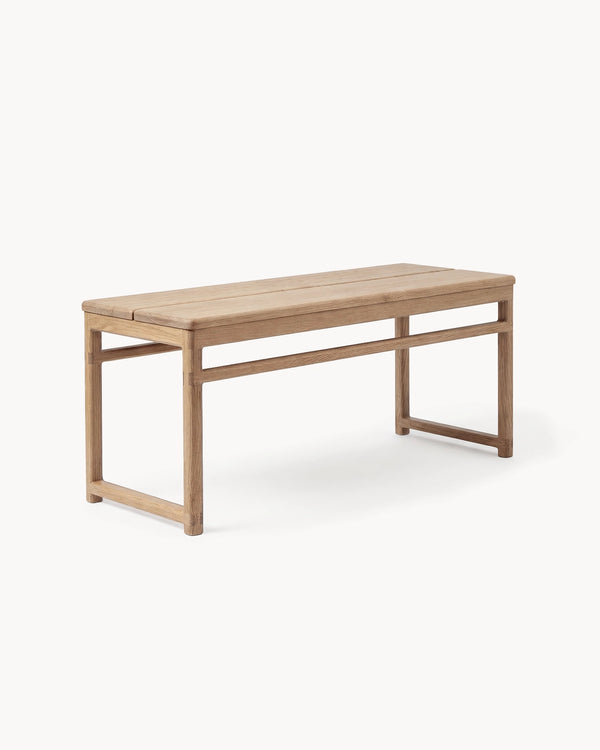
That is the difference that matters over the years. Solid oak can be sanded and relacquered when it is marked. A veneer is a thin slice of oak glued over board: once a scratch is through it, the board shows. A foil or laminate is a printed picture of oak, with no wood on the surface at all.
What is solid oak furniture?
Furniture whose wooden parts are cut from oak timber all the way through. A knock on the edge shows oak underneath, and the grain on the top carries on round the edge.
Solid oak, veneer or oak on steel?
Solid oak throughout and a solid oak top on welded steel both last for decades; veneer over board does not take the same wear or the same repairs.
We make the first two. Oak on steel is not a compromise: the top you touch, eat at and put your cup on is the same solid oak, and a welded steel frame is strong enough to stay slim where timber would need a thicker section.
| Construction | What it is | When it is marked | Ours |
|---|---|---|---|
| Solid oak throughout | Every wooden part cut from oak timber | Sand and relacquer | Ann, Alva, Affe, Erik, Karin, Einar, Ebba, Eva, Ted, Carl |
| Solid oak top on welded steel | A solid oak top on a steel frame | Sand and relacquer the top | Melker, Diana, Luna, Lisa, Leo in oak |
| Oak veneer over board | A thin oak face glued to chipboard or MDF | Through the veneer, the board shows | None |
| Oak-look foil or laminate | A printed image of oak | Cannot be sanded | None |
How can you tell solid oak from veneer?
Look at the edge and the end grain. On solid oak the grain on the top runs round the edge and shows on the end of a leg; on veneer the edge is a separate strip, or a thin line of oak over a different core.
Two more checks in a shop. Look underneath, where veneered pieces often show bare board. And read the description for the words solid oak, not oak finish, oak effect or oak veneer. If the listing does not say, ask.
Where does our oak come from?
From Germany. We use solid A-grade German oak, bought as FSC-certified timber, which means it comes from responsibly managed forests.
We cut, shape, lacquer and assemble it in our own factory in Sweden, and inspect each piece by hand before it ships. The same oak goes into our dining tables, chairs, armchairs, bar stools, benches and bedside tables, which is why a set bought over several years still matches.
The steel under our oak tops is welded and powder-coated in the same factory.
Natural, dark or black oak: what are the finishes?
The same oak with three looks. Natural oak is a clear matte lacquer over the raw colour. Dark oak is a tobacco-brown stain under the same lacquer. Black oak is a black stain with the grain still showing.
On Einar, the dark tone comes from an Osmo oil-based stain that meets EN 71.3, the European safety standard for children's toys, sealed under the matte lacquer. All three finishes run across our oak range, so a table, chairs, a bench and bedside tables can match from room to room.
Colour on a screen is a guess. Order wood samples and look at them in your own light, next to your floor.
Does solid oak furniture need oiling?
Not ours. Our oak is sealed with a matte lacquer, so it never needs oil or wax; oil would just sit on top.
Care is a barely damp cloth, a drop of mild soap if needed, and drying it off. Avoid standing water, hot pans straight on the lacquer and silicone polish. Use a coaster under a sweating glass and a trivet under a hot dish.
A deep mark through the lacquer is not the end of a solid piece: it can be sanded and relacquered. On veneer, the same sanding would go through to the board. Our oak dining table guide covers tables in detail.
Why does solid oak furniture last?
Because oak is a hardwood that can be repaired, and because a well-made piece is joined, not just screwed together.
Oak is hard-wearing and ages well: the sun warms its colour over time and it gathers character instead of looking worn. Glued joints in solid hardwood have nothing to work loose. Our oak chairs, bar stools and the Einar armchair are rated for 200 kg, and every piece carries a 10-year warranty.
What wears out on furniture is usually the fabric and the foam, long before a good frame. That is why our upholstered seats and cushions can be replaced. Our guide to sustainable furniture goes through the rest.
Which of our furniture is solid oak?
Every oak piece we make, in every room. Find the guide for the piece you are looking at:
- Dining tables: oak dining table, with Ann, Melker, Diana and Luna
- Dining chairs: chairs for an oak table, with Erik and Karin
- Armchairs: oak or steel armchair, with Einar
- Bar stools: oak bar stools, with Ebba, Eva, Ted and Carl
- Coffee tables: oak coffee table, with Leo
- Benches: oak bench, with Alva
- Bedside tables: oak bedside table, with Lisa and Affe
The whole range is in our oak collection.
Oak all the way through
- Veneer
- none
- Care
- damp cloth, no oil
- Warranty
- 10 years