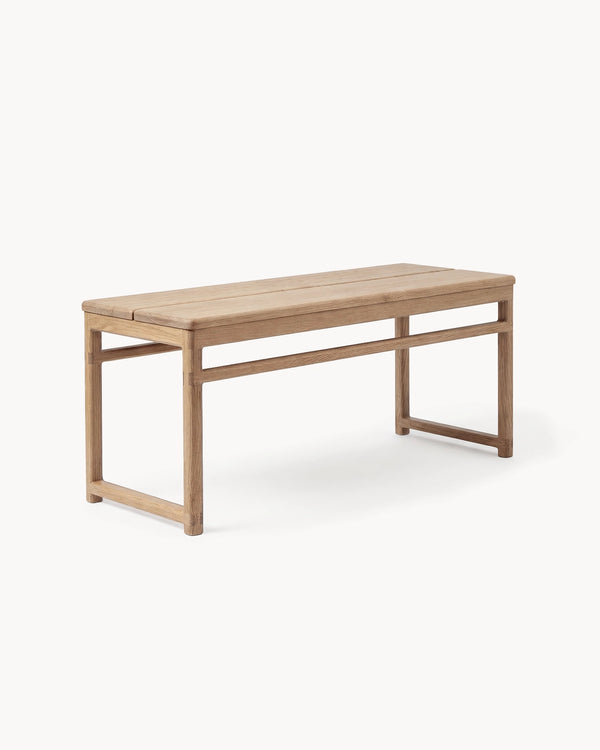
Japandi is one of the most searched interior styles of recent years, and the name says what it is: Japan plus Scandi. Both traditions prize natural materials, plain shapes and things made to last. Japandi takes the Nordic focus on comfort and function and adds the Japanese taste for low lines, darker wood, empty space and visible craft. This guide covers what makes furniture Japandi, which woods and colors carry it, and how to furnish a living room, a dining room and a bedroom in the style with pieces made in Sweden.
What is Japandi style?
A blend of Scandinavian and Japanese interior design: natural materials, plain shapes and comfort, with a lower, darker and even more minimal palette than a classic Nordic room.
A Scandinavian room is usually light and soft. A Japandi room is calmer and darker, with more contrast between wood and black, more empty floor and fewer objects on show. Craft matters in both: a visible joint, the grain of solid wood, a frame welded into one clean line.
The common ground is a long life. Neither tradition buys things to replace them next season.
What furniture is Japandi?
Low, plain pieces in solid wood or dark metal, with nothing added for decoration.
In practice: a low coffee table, an armchair with a deep, low seat, a dining table in solid oak on a calm frame, a bench instead of a row of extra chairs, and bedside tables that float on the wall or stand on one leg. Storage closes; surfaces stay clear.
Rattan, paper lamps, linen and ceramics often complete a Japandi room. We make none of those. What we make is the furniture they sit beside: solid oak, black steel and sintered stone.
Which woods and colors suit Japandi?
Dark oak, black oak and natural oak, with black steel, warm grays and off-white. Keep to two or three tones per room.
Our three oak finishes are the same timber with a different stain under a matte lacquer, and the grain shows through all of them. Order wood samples and look at them in your own light: a dark finish reads very differently by a north-facing window.
Which woods and colors suit Japandi?| Finish | How it reads | Its role in a Japandi room |
|---|
| Natural oak | Light and warm | The Scandinavian side; pair it with black |
|---|
| Dark oak | Tobacco brown | The core Japandi wood |
|---|
| Black oak | Graphic, grain still visible | Contrast and outline |
|---|
| Black steel frame | A thin dark line | Ties wood and stone together |
|---|
| Greige or black bouclé | Soft and textured | Warmth without color |
|---|
How do you furnish a Japandi living room?
Low seating, a low table and space between them. Leave more floor than you think you need.
An armchair with a deep, low seat is the anchor: Einar in dark or black oak, or Kent on black steel, both with a 15 in seat. Dark oak with greige bouclé is the calmest pairing. In front of it, a low coffee table: Anton and Leo stand 16.3 to 20.7 in high, with tops in Grafite, Grigio or Sabbia Dekton, a sintered stone that needs no sealing.
One side table, one lamp, one plant. Our guide to how to furnish a living room covers the layout around the sofa.
How do you furnish a Japandi dining room?
Around one solid table on a calm frame, with chairs and a bench in the same dark wood or in black.
Luna is a round oak top on crossed steel legs, a soft shape that suits Japandi in dark or black oak. Ann is solid oak through the top and the legs; Melker and Diana set an oak top on a black steel frame, and Diana also comes in Grafite Dekton. Chairs in dark or black oak, such as Erik and Karin, or black steel frames with a black bouclé seat, sit comfortably at any of them. A bench on one side keeps the room low.
On the table, one low object and nothing else. Keep the light low and warm, with a floor candle holder beside the table rather than a tall centerpiece. See how to style a dining table and our black dining table guide.
How do you furnish a Japandi bedroom?
A low bed, a clear floor and small, quiet pieces beside it.
Lisa is a solid oak shelf screwed to the wall at mattress height, so the floor under it stays empty. Affe is a turned solid oak pedestal, 23 in high, the bedside table for a low bed. At the foot of the bed, a solid oak bench such as Alva in dark or black oak takes the clothes that would otherwise land on a chair.
Keep to one wood tone and one textile color. Our guide to bedroom furniture has the measurements.
What is the difference between Japandi and Scandinavian?
Scandinavian is lighter and softer; Japandi is lower, darker and emptier. Both use natural wood, plain shapes and things made to last, which is why they mix so easily.
In our range, natural oak and ivory bouclé lean Scandinavian; dark and black oak, black steel and black or greige bouclé lean Japandi. Mixing works when one side leads: a dark oak table with natural oak chairs looks chosen, half and half looks undecided.
For the whole Nordic picture, room by room, see Scandinavian interior design; for the 1950s cousin, mid-century or Scandinavian.
Low, dark, calm and made to last
- Armchair seat
- 15 in
- Coffee tables
- 16.3 to 20.7 in
- Warranty
- 10 years
Japandi furniture is solid wood and dark metal in low, plain shapes, with space left around it. Choose dark or black oak and black steel, keep to two or three tones, and give each room one anchor piece. Ours are made in our own factory in Sweden with a 10-year warranty.
Frequently asked questions
What is Japandi style?
A mix of Scandinavian and Japanese design: natural materials, plain shapes and comfort, with lower lines, darker wood, fewer objects and more empty space than a classic Nordic room.
What furniture is used in Japandi?
Low, plain pieces in solid wood or dark metal: a low coffee table, a deep, low armchair, a solid oak dining table, a bench, and small bedside tables that float or stand on one leg.
What colors are Japandi?
Dark and natural wood, black, warm gray, greige and off-white. Two or three tones per room, with texture from bouclé, linen and ceramics.
Is dark oak Japandi?
Yes. Dark oak is the core Japandi wood, and black oak adds contrast. Natural oak works too if black steel or dark textiles balance it.
What is the difference between Japandi and Scandinavian?
Scandinavian is lighter and softer. Japandi is lower, darker and more minimal. Both use natural wood and plain shapes, so they mix well.
Is a round dining table Japandi?
It can be. A round oak top on a calm frame, like Luna in dark or black oak, suits the soft, quiet side of the style.