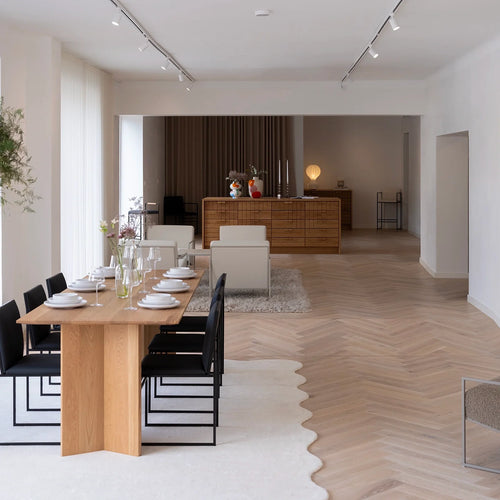
The top is the part of a dining table you touch every day, and the material decides what a spilt glass of wine costs you. This guide compares the four tops people search for most: solid oak, sintered stone, glass and marble. We make oak and Dekton tables in our own factory in Sweden. We do not make glass or marble tables, so those two are compared honestly, not sold.
Which material is best for a dining table?
For most homes, solid oak or sintered stone. Oak for warmth and a top you can refinish; sintered stone for a top that shrugs off heat and stains. Glass and marble look good but ask more of you every day.
Which material is best for a dining table?| Top | Heat | Stains and spills | Everyday care | Do we make it? |
|---|
| Solid oak, lacquered | Trivet under hot pans | Wipe up; mat under wine and standing water | Damp cloth, mild soap; no oil | Yes: Ann, Melker, Diana, Luna |
|---|
| Dekton sintered stone | Resists heat | Does not absorb; wipes off | Damp cloth, mild soap; no sealing | Yes: Diana |
|---|
| Glass | Trivet; sudden heat is the risk | Does not absorb; shows smears | Glass cleaner, often | No |
|---|
| Marble | Trivet | Porous: wine, oil and lemon mark it | Sealing and marble cleaner | No |
|---|
Solid oak: what it does well and what it needs
Oak is warm to the touch, quiet under plates and lasts for decades. It needs a mat under hot pans and a cloth for standing water.
Ann is solid oak, top and legs. Melker, Diana and Luna put a solid oak top on a welded steel frame. The oak is A-grade, FSC-certified German oak, sealed with a natural matte lacquer, in Oak, Dark Oak or Black Oak. Not veneer, and never oiled: the lacquer is the protection.
The trade-off: a hot pan or a glass left overnight can mark the lacquer. A deep mark is a refinish, not the end of the table. More in the oak dining table guide.
Dekton sintered stone: what it is
Dekton is a sintered stone from Cosentino: minerals fired under high pressure into a dense slab. It does not absorb, so it needs no sealing, and it resists heat and stains.
It is on Diana indoors, in Grafite (near-black), Grigio (mid gray) and Sabbia (sandy beige), on a welded steel frame. A fruit bowl, a candle tray or a hot dish can go straight on it, though a trivet is still kind to the top.
It is not marble and not a marble-effect laminate. The marble or Dekton guide sets the two side by side.
Is a ceramic table the same as sintered stone?
Close relatives. Both are minerals fired into a dense, non-porous surface, so both resist heat and stains far better than wood, glass or marble.
The usual weak point of any fired stone top is the edge: a hard knock from a cast-iron pan can chip it. Buy from a maker who names the material and stands behind it. Ours is Dekton: a chip comes to us as a claim, with a photo, not to a grinder. To clean it, a damp cloth and mild soap; no marble cream and no abrasive pads.
Glass dining table: pros and cons
Glass makes a small room look bigger because you see the floor through it. It also shows every fingerprint, crumb and smear, and it is cold and loud under cutlery.
We do not make glass tables. If you want the light, open look without the cleaning, a slim steel frame does much of the same work: Melker, Diana and Luna stand on welded steel, so the room still reads past the legs. A round Luna ø43.5 in takes very little visual space in a small room.
Marble dining table: pros and cons
Marble is beautiful and every slab is different. It is also porous and soft: red wine, oil and lemon juice can stain or etch it, and it needs sealing and gentle cleaners.
We do not make marble tables. Our stone is Dekton, which some people choose for the look of stone without that care. The marble or Dekton guide has the full comparison.
Which material for which household?
Children and daily use: Dekton, or oak with mats. Working at the table: oak, it is warmer and quieter under a laptop. Entertaining with red wine: Dekton. A small, light room: oak or stone on a slim steel frame.
Order material samples and put them on the table you have now for a week. Light, plates and cups change how a top looks more than any photo.
Oak for warmth, Dekton for no worry
- Oak finishes
- Oak, Dark Oak, Black Oak
- Dekton colors
- Grafite, Grigio, Sabbia
- Sealing
- none needed
Solid oak is warm, quiet and refinishable. Dekton takes heat and stains and needs no sealing. Glass looks light and shows everything. Marble is beautiful and porous. We make oak and Dekton tables in Sweden, with a 10-year warranty.
Frequently asked questions
What is the most durable dining table material?
Sintered stone such as Dekton resists heat, stains and scratches best. Solid oak is durable in another way: it can be refinished when it wears.
Are wooden dining tables better than glass?
For most homes, yes. Wood is warmer, quieter and hides daily marks; glass shows every fingerprint. Glass does make a small room feel more open.
Is a marble dining table practical?
Only with care. Marble is porous, so wine, oil and lemon can stain or etch it, and it needs sealing. Dekton gives a stone top without that.
What are the disadvantages of a ceramic or sintered stone table?
A hard knock on the edge can chip it, and it feels colder than wood. Heat and stains are not the problem.
Does Dekton need sealing?
No. It does not absorb, so a damp cloth and mild soap are enough.
Do you make glass or marble dining tables?
No. We make dining tables in solid oak and in Dekton sintered stone.