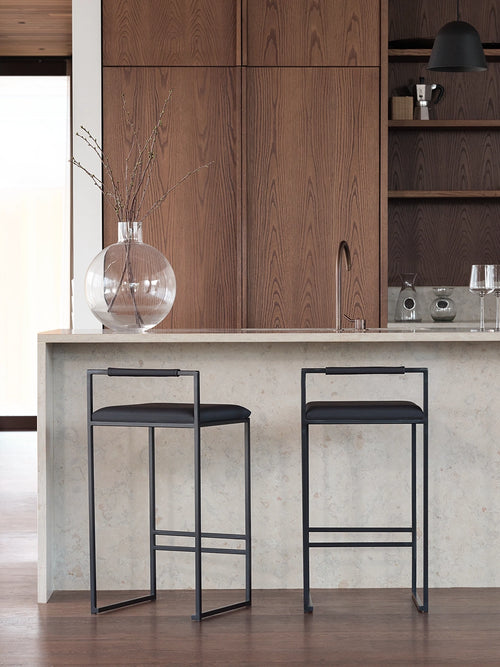
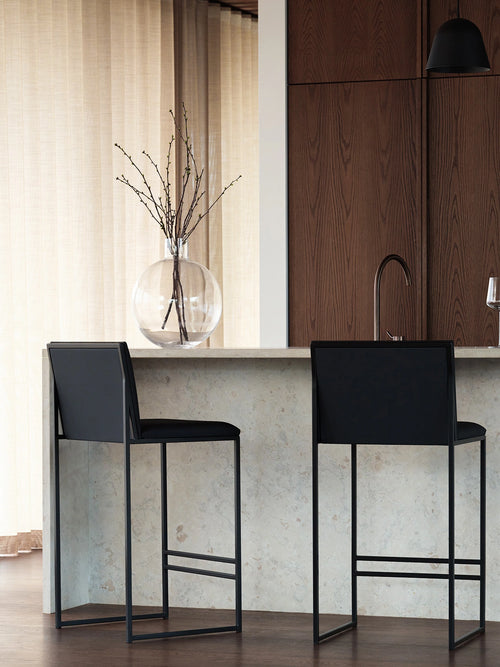
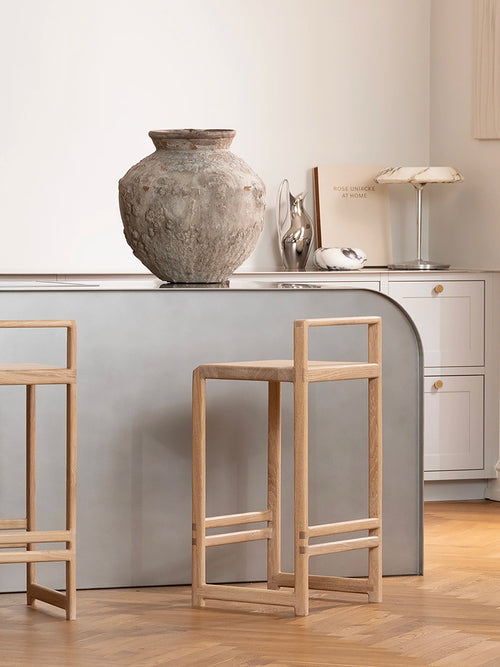
This image shows 10 Ebba barstools from by Crea in dark stained oak in a Dark oak minimalistic kitchen with contemporary light stone marble top.
Image Link

Stool width affects comfort, spacing, and how many seats fit along a counter.This page explains stool width using ergonomic rules and exact measurements.The goal is to help you choose a stool that feels comfortable without overcrowding your kitchen or bar.The focus is width, not height or style.

Stool width affects comfort, spacing, and how many seats fit along a counter.This page explains stool width using ergonomic rules and exact measurements.The goal is to help you choose a stool that feels comfortable without overcrowding your kitchen or bar.The focus is width, not height or style.

1. What stool width means ergonomically

Stool width is the horizontal measurement of the seat.It determines how much lateral space the body has while sitting.Too little width causes pressure at the hips and thighs.Too much width reduces usable seating space along the counter.Stool width directly affects comfort during longer sitting.Stool width also determines how many stools fit side by side.

Stool width is the horizontal measurement of the seat.It determines how much lateral space the body has while sitting.Too little width causes pressure at the hips and thighs.Too much width reduces usable seating space along the counter.Stool width directly affects comfort during longer sitting.Stool width also determines how many stools fit side by side.

See more See more
Bar Stool Svea in black with ivory bouclé fabric beside a modern marble kitchen island. Bar Stool Svea in black with ivory bouclé fabric beside a modern marble kitchen island.

2. Narrow stools: space efficiency vs comfort

Narrow stools prioritise fitting more seats into limited space.They are common in small kitchens and compact islands.Comfort is acceptable for short sitting periods.Lateral support is limited.Typical characteristics of narrow stools✓ Seat width: 35–38 cm (13.8–15 in)✓ Best for: small kitchens and tight layouts✓ Sitting duration comfort: short✓ Spacing efficiency: highNarrow stools work best when seating is occasional.See compact designs in the bar stool collectionhttps://www.by-crea.com/collections/barstools

Narrow stools prioritise fitting more seats into limited space.They are common in small kitchens and compact islands.Comfort is acceptable for short sitting periods.Lateral support is limited.Typical characteristics of narrow stools✓ Seat width: 35–38 cm (13.8–15 in)✓ Best for: small kitchens and tight layouts✓ Sitting duration comfort: short✓ Spacing efficiency: highNarrow stools work best when seating is occasional.See compact designs in the bar stool collectionhttps://www.by-crea.com/collections/barstools

See furniture See furniture

3. Standard-width stools: balanced comfort

Standard-width stools balance comfort and spacing.They are the most versatile option for home kitchens.The seat supports the hips without forcing wide spacing.Comfort remains stable for medium sitting durations.Typical characteristics of standard-width stools✓ Seat width: 40–45 cm (15.7–17.7 in)✓ Best for: kitchen islands and counters✓ Sitting duration comfort: short to medium✓ Spacing efficiency: balancedThis width works well for both home and hospitality use.

Standard-width stools balance comfort and spacing.They are the most versatile option for home kitchens.The seat supports the hips without forcing wide spacing.Comfort remains stable for medium sitting durations.Typical characteristics of standard-width stools✓ Seat width: 40–45 cm (15.7–17.7 in)✓ Best for: kitchen islands and counters✓ Sitting duration comfort: short to medium✓ Spacing efficiency: balancedThis width works well for both home and hospitality use.

Explore Counter Stools Explore Counter Stools
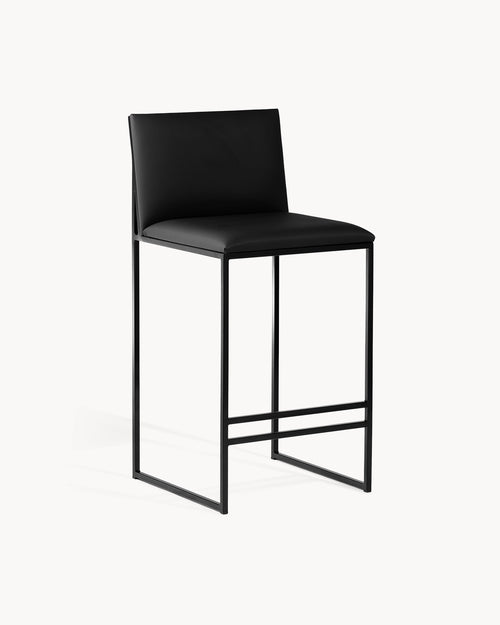
Freja bar stool by by Crea, black frame and black leather seat, Scandinavian kitchen island seating in a minimalist home. Ebba Bar Stools in dark oak with minimal Scandinavian design, placed at a statement kitchen island in dramatic veined marble, complemented by rich wood cabinetry and herringbone oak flooring.

4. Wide stools: comfort with space trade-offs

Wide stools prioritise comfort and support.They allow more freedom of movement while seated.They reduce pressure points during long sitting.The trade-off is fewer stools per counter length.Typical characteristics of wide stools✓ Seat width: 46–50 cm (18.1–19.7 in)✓ Best for: long sitting and dining-style use✓ Sitting duration comfort: medium to long✓ Spacing efficiency: lowWide stools suit large kitchens and generous island layouts.

Wide stools prioritise comfort and support.They allow more freedom of movement while seated.They reduce pressure points during long sitting.The trade-off is fewer stools per counter length.Typical characteristics of wide stools✓ Seat width: 46–50 cm (18.1–19.7 in)✓ Best for: long sitting and dining-style use✓ Sitting duration comfort: medium to long✓ Spacing efficiency: lowWide stools suit large kitchens and generous island layouts.

Explore Bar Stools Explore Bar Stools
Eva Bar stools in black oak at a modern kitchen island with marble countertop, showcasing clean lines and a slim profile. Svea bar stools with black frame and latte leather seat, minimalistic design for modern kitchen or dining area.

5. Stool width and spacing along the counter

Stool width alone does not determine how many stools fit.Clearance between stools is equally important.Insufficient spacing causes elbow and shoulder contact.Recommended spacing rules✓ Minimum space per stool: 50 cm (19.7 in)✓ Comfortable space per stool: 55–60 cm (21.7–23.6 in)This spacing includes the seat width and side clearance.Ignoring spacing leads to discomfort even with wide seats.

Stool width alone does not determine how many stools fit.Clearance between stools is equally important.Insufficient spacing causes elbow and shoulder contact.Recommended spacing rules✓ Minimum space per stool: 50 cm (19.7 in)✓ Comfortable space per stool: 55–60 cm (21.7–23.6 in)This spacing includes the seat width and side clearance.Ignoring spacing leads to discomfort even with wide seats.

Explore Freja Counter Stool Explore Freja Counter Stool

6. Stool width vs material and construction

Material affects how width is perceived.Hard materials feel narrower at the same width.Upholstered seats feel more forgiving.Steel-framed stools often use slimmer proportions.Wooden stools often feel wider due to solid construction.Material considerations✓ Upholstered seat: feels comfortable at smaller widths✓ Solid wood seat: benefits from slightly more width✓ Steel frame with cushion: balances slim design and comfortCompare steel and wooden stools for construction differenceshttps://www.by-crea.com/collections/steel-barstoolshttps://www.by-crea.com/collections/wooden-barstools

Material affects how width is perceived.Hard materials feel narrower at the same width.Upholstered seats feel more forgiving.Steel-framed stools often use slimmer proportions.Wooden stools often feel wider due to solid construction.Material considerations✓ Upholstered seat: feels comfortable at smaller widths✓ Solid wood seat: benefits from slightly more width✓ Steel frame with cushion: balances slim design and comfortCompare steel and wooden stools for construction differenceshttps://www.by-crea.com/collections/steel-barstoolshttps://www.by-crea.com/collections/wooden-barstools

Bar Stool Freja in black frame, black leather cushion, and brown backrest at a modern kitchen island. Bar Stool Freja in black frame, black leather cushion, and brown backrest at a modern kitchen island.

7. Common mistakes when choosing stool width

Choosing the widest stool available is a common mistake.Wider stools reduce seating capacity quickly.Choosing very narrow stools for daily meals is another mistake.This leads to discomfort over time.Mistake prevention rules✓ Match stool width to sitting duration✓ Account for spacing, not just seat size✓ Avoid mixing widths along the same counter

Choosing the widest stool available is a common mistake.Wider stools reduce seating capacity quickly.Choosing very narrow stools for daily meals is another mistake.This leads to discomfort over time.Mistake prevention rules✓ Match stool width to sitting duration✓ Account for spacing, not just seat size✓ Avoid mixing widths along the same counter

Learn about our materials Learn about our materials

8. The core rule for stool width comfort

Seat width should match sitting time and available counter length.Short sitting allows narrower stools.Long sitting requires more width.Ignoring spacing reduces comfort regardless of width.

Seat width should match sitting time and available counter length.Short sitting allows narrower stools.Long sitting requires more width.Ignoring spacing reduces comfort regardless of width.

About us About us
Oak Bar Stool Carl in dark oak with ivory bouclé in a modern kitchen setting with marble countertops. Oak Bar Stool Carl in dark oak with ivory bouclé in a modern kitchen setting with marble countertops.

9. Stool width decision checklist

✓ Measure available counter length✓ Decide how many stools are required✓ Allow 55–60 cm (21.7–23.6 in) per stool for comfort✓ Choose narrow width for small kitchens✓ Choose standard width for daily kitchen use✓ Choose wide width only if space allows✓ Match width with material stiffness

✓ Measure available counter length✓ Decide how many stools are required✓ Allow 55–60 cm (21.7–23.6 in) per stool for comfort✓ Choose narrow width for small kitchens✓ Choose standard width for daily kitchen use✓ Choose wide width only if space allows✓ Match width with material stiffness

Explore Counter Stools Explore Counter Stools

Conclusion

Stool width directly affects comfort and how many stools fit.For most kitchens, standard-width stools provide the best balance.Narrow stools save space but limit comfort.Wide stools improve comfort but reduce seating capacity.Always evaluate width together with spacing and material choice.If uncertainty remains, request guidancehttps://by-crea.com/pages/contact

Stool width directly affects comfort and how many stools fit.For most kitchens, standard-width stools provide the best balance.Narrow stools save space but limit comfort.Wide stools improve comfort but reduce seating capacity.Always evaluate width together with spacing and material choice.If uncertainty remains, request guidancehttps://by-crea.com/pages/contact

Counter stools & Bar stools FAQ

What is the most comfortable stool width for a kitchen island?

A seat width of 40–45 cm (15.7–17.7 in) balances comfort and spacing.This range suits most kitchen islands.It supports medium sitting durations.It allows practical spacing between stools.

How do I compare stool widths before ordering?

Check seat width measurements carefully.Compare spacing requirements with your counter length.Material and cushion thickness also matter.If unsure, request guidancehttps://by-crea.com/pages/contact

How much space should I allow per stool?

Allow at least 50 cm (19.7 in) per stool.For better comfort, allow 55–60 cm (21.7–23.6 in).This includes side clearance.Less space causes shoulder and elbow contact.

Does upholstery affect perceived width?

Upholstery makes seats feel softer.This allows slightly narrower seats to feel comfortable.Hard seats require more width.Material choice affects perceived comfort.

Do wider stools always feel better?

Wider stools feel better during long sitting.They do not improve comfort for short use.They reduce the number of stools that fit.Comfort depends on width and spacing together.

Are narrow bar stools uncomfortable?

Narrow stools are comfortable for short sitting.They are less comfortable for long meals.They work best in small kitchens.Comfort decreases as sitting time increases.