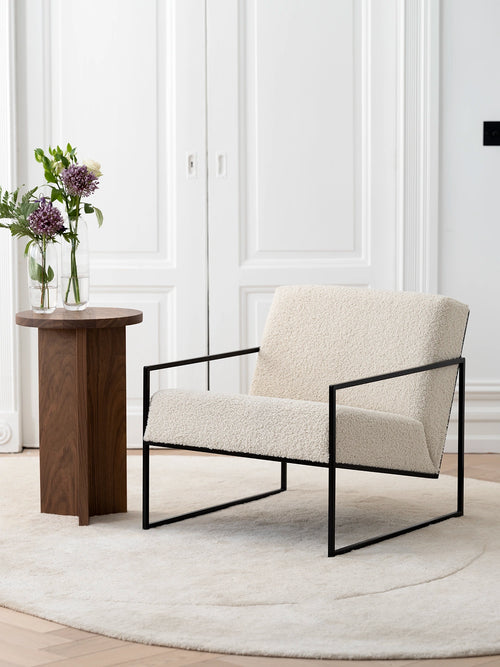
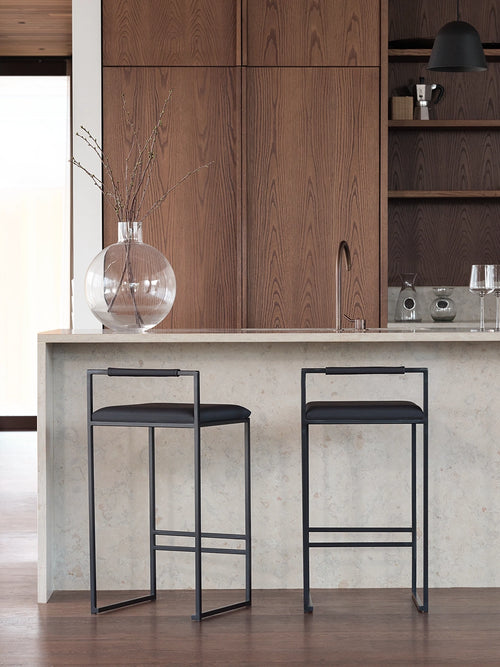
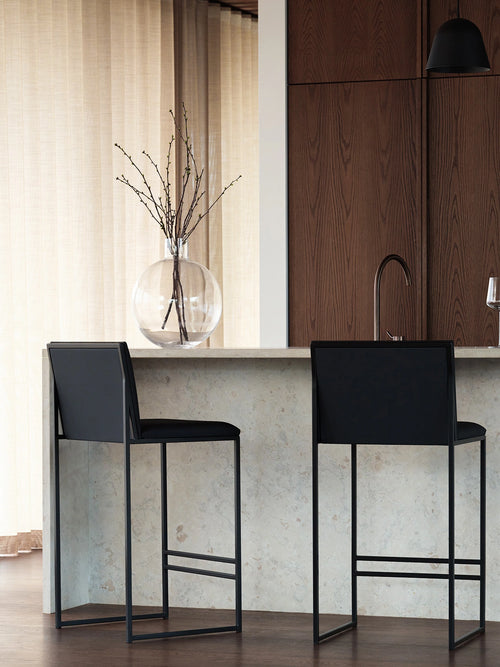
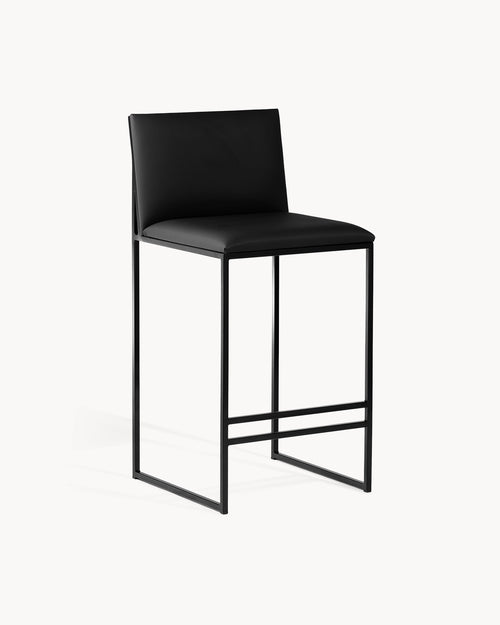
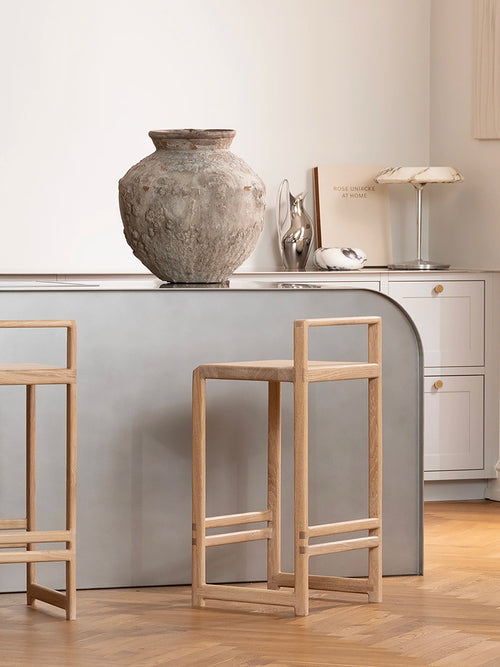
This image shows 10 Ebba barstools from by Crea in dark stained oak in a Dark oak minimalistic kitchen with contemporary light stone marble top.
Image Link

Choosing the correct stool height is an ergonomic decision.

It affects posture, comfort, clearance, and how usable a kitchen or bar area feels day to day.

Bar stools and counter stools are not interchangeable.

They are designed for different surface heights and different clearances.

This guide explains the difference using exact measurements.

All values are stated in cm with inches in parentheses for clarity.

Choosing the correct stool height is an ergonomic decision.

It affects posture, comfort, clearance, and how usable a kitchen or bar area feels day to day.

Bar stools and counter stools are not interchangeable.

They are designed for different surface heights and different clearances.

This guide explains the difference using exact measurements.

All values are stated in cm with inches in parentheses for clarity.

1. What is the difference between a bar stool and a counter stool?

A counter stool is designed for standard kitchen counters and islands.

A bar stool is designed for higher bar-height surfaces.

The difference is defined by seat height.

Seat height must match the counter height to maintain a safe and comfortable sitting gap.

Counter stools are the correct choice for most modern kitchens.

Bar stools are only correct when the surface is significantly higher.

A counter stool is designed for standard kitchen counters and islands.

A bar stool is designed for higher bar-height surfaces.

The difference is defined by seat height.

Seat height must match the counter height to maintain a safe and comfortable sitting gap.

Counter stools are the correct choice for most modern kitchens.

Bar stools are only correct when the surface is significantly higher.

See more See more
Bar Stool Svea in black with ivory bouclé fabric beside a modern marble kitchen island. Bar Stool Svea in black with ivory bouclé fabric beside a modern marble kitchen island.

2. Counter stool height explained (kitchen counters & islands)

Counter stools are made for standard kitchen worktops and islands.

Typical use cases include home kitchens and open-plan living areas.

This height allows relaxed seating without raised shoulders or dangling feet.

Counter stools (kitchen islands & counters)

✓ Typical counter height: 88–92 cm (35–36 in)

✓ Ideal counter stool seat height: 65–66 cm (25.5–26 in)

✓ Comfort gap between seat and counter underside: 23–26 cm (9–10 in)

A 66 cm counter stool is the ergonomic reference point for a 90 cm counter.

This applies to both residential kitchens and light hospitality use.

For visual reference, see the Bar stool Collection after reviewing the measurements.

https://www.by-crea.com/collections/barstools

Counter stools are made for standard kitchen worktops and islands.

Typical use cases include home kitchens and open-plan living areas.

This height allows relaxed seating without raised shoulders or dangling feet.

Counter stools (kitchen islands & counters)

✓ Typical counter height: 88–92 cm (35–36 in)

✓ Ideal counter stool seat height: 65–66 cm (25.5–26 in)

✓ Comfort gap between seat and counter underside: 23–26 cm (9–10 in)

A 66 cm counter stool is the ergonomic reference point for a 90 cm counter.

This applies to both residential kitchens and light hospitality use.

For visual reference, see the Bar stool Collection after reviewing the measurements.

https://www.by-crea.com/collections/barstools

See furniture See furniture

3. Bar stool height explained (raised bars & hospitality)

Bar stools are designed for higher-than-standard surfaces.

They are common in bars, cafés, and purpose-built home bars.

Using bar stools at a normal kitchen counter creates poor posture.

The seat ends up too high, reducing leg clearance and stability.

Bar stools (bar-height surfaces)

✓ Typical bar height: 100–110 cm (39–43 in)

✓ Ideal bar stool seat height: 75–76 cm (29.5–30 in)

✓ Comfort gap between seat and bar underside: 24–30 cm (9.5–12 in)

Bar stools should only be used when the surface height requires them.

If the counter is under 95 cm, a bar stool is usually incorrect.

Bar stools are designed for higher-than-standard surfaces.

They are common in bars, cafés, and purpose-built home bars.

Using bar stools at a normal kitchen counter creates poor posture.

The seat ends up too high, reducing leg clearance and stability.

Bar stools (bar-height surfaces)

✓ Typical bar height: 100–110 cm (39–43 in)

✓ Ideal bar stool seat height: 75–76 cm (29.5–30 in)

✓ Comfort gap between seat and bar underside: 24–30 cm (9.5–12 in)

Bar stools should only be used when the surface height requires them.

If the counter is under 95 cm, a bar stool is usually incorrect.
Explore Counter Stools Explore Counter Stools
Freja bar stool by by Crea, black frame and black leather seat, Scandinavian kitchen island seating in a minimalist home. Ebba Bar Stools in dark oak with minimal Scandinavian design, placed at a statement kitchen island in dramatic veined marble, complemented by rich wood cabinetry and herringbone oak flooring.

4. Bar stool vs counter stool: direct comparison

This comparison resolves the most common source of confusion.

The decision is determined by surface height, not by style or name.

Counter stool vs bar stool

✓ Counter stool seat height: 65–66 cm (25.5–26 in)

✓ Bar stool seat height: 75–76 cm (29.5–30 in)

✓ Height difference between the two: ~10 cm (~4 in)

A 10 cm difference may look small on paper.

In daily use, it strongly affects comfort and safety.

This comparison resolves the most common source of confusion.

The decision is determined by surface height, not by style or name.

Counter stool vs bar stool

✓ Counter stool seat height: 65–66 cm (25.5–26 in)

✓ Bar stool seat height: 75–76 cm (29.5–30 in)

✓ Height difference between the two: ~10 cm (~4 in)

A 10 cm difference may look small on paper.

In daily use, it strongly affects comfort and safety.

Explore Bar Stools Explore Bar Stools
Eva Bar stools in black oak at a modern kitchen island with marble countertop, showcasing clean lines and a slim profile. Svea bar stools with black frame and latte leather seat, minimalistic design for modern kitchen or dining area.

5. What stool height do I need for a 90 cm kitchen counter?

A 90 cm kitchen counter is the European standard.

This includes most modern kitchen islands.

The correct solution is fixed and measurable.

There is no alternative height that performs as well ergonomically.

For a 90 cm kitchen counter

✓ Recommended stool type: Counter stool

✓ Recommended seat height: 66 cm (26 in)

✓ Target clearance under counter: 24 cm (9.5 in)

If the seat height is higher, knees hit the counter.

If the seat height is lower, posture becomes unsupported.

A 90 cm kitchen counter is the European standard.

This includes most modern kitchen islands.

The correct solution is fixed and measurable.

There is no alternative height that performs as well ergonomically.

For a 90 cm kitchen counter

✓ Recommended stool type: Counter stool

✓ Recommended seat height: 66 cm (26 in)

✓ Target clearance under counter: 24 cm (9.5 in)

If the seat height is higher, knees hit the counter.

If the seat height is lower, posture becomes unsupported.

Explore Freja Counter Stool Explore Freja Counter Stool

6. Counter stools vs bar stools in small kitchens

Small kitchens magnify height mistakes.

Clearance and movement become more critical.

Counter stools are almost always the correct choice.

They sit lower and maintain better visual and physical openness.

Small kitchen guidance

✓ Prefer counter stools over bar stools

✓ Avoid excess seat height above 66 cm (26 in)

✓ Ensure footrests align with natural leg position

Slim-profile counter stools reduce visual weight.

They also make it easier to slide stools fully under the counter.

For compact layouts, see Wooden Bar stools or Steel Bar stools after measuring.

https://www.by-crea.com/collections/wooden-barstools

https://www.by-crea.com/collections/steel-barstools

Small kitchens magnify height mistakes.

Clearance and movement become more critical.

Counter stools are almost always the correct choice.

They sit lower and maintain better visual and physical openness.

Small kitchen guidance

✓ Prefer counter stools over bar stools

✓ Avoid excess seat height above 66 cm (26 in)

✓ Ensure footrests align with natural leg position

Slim-profile counter stools reduce visual weight.

They also make it easier to slide stools fully under the counter.

For compact layouts, see Wooden Bar stools or Steel Bar stools after measuring.

https://www.by-crea.com/collections/wooden-barstools

https://www.by-crea.com/collections/steel-barstools

Bar Stool Freja in black frame, black leather cushion, and brown backrest at a modern kitchen island. Bar Stool Freja in black frame, black leather cushion, and brown backrest at a modern kitchen island.

7. Steel vs wood stools and height accuracy

Material choice does not change required height.

Ergonomic rules apply equally to steel and wood stools.

What differs is tolerance and rigidity.

Steel frames hold precise heights with minimal flex.

Material considerations

✓ Steel stools maintain exact seat height over time

✓ Wood stools can vary slightly due to joinery and material movement

✓ Footrest placement is critical regardless of material

Both materials can be used in kitchens and hospitality.

Height accuracy matters more than material choice.

Material choice does not change required height.

Ergonomic rules apply equally to steel and wood stools.

What differs is tolerance and rigidity.

Steel frames hold precise heights with minimal flex.

Material considerations

✓ Steel stools maintain exact seat height over time

✓ Wood stools can vary slightly due to joinery and material movement

✓ Footrest placement is critical regardless of material

Both materials can be used in kitchens and hospitality.

Height accuracy matters more than material choice.

Learn about our materials Learn about our materials

8. The universal stool height rule

This rule resolves nearly all stool height questions.

Stool height rule

✓ Measure counter height first

✓ Subtract 24–26 cm (9–10 in)

✓ The result is the correct seat height

If the result is near 66 cm, choose a counter stool.

If the result is near 76 cm, choose a bar stool.

If the result falls outside standard sizes, a custom height is required.

This rule resolves nearly all stool height questions.

Stool height rule

✓ Measure counter height first

✓ Subtract 24–26 cm (9–10 in)

✓ The result is the correct seat height

If the result is near 66 cm, choose a counter stool.

If the result is near 76 cm, choose a bar stool.

If the result falls outside standard sizes, a custom height is required.

About us About us
Oak Bar Stool Carl in dark oak with ivory bouclé in a modern kitchen setting with marble countertops. Oak Bar Stool Carl in dark oak with ivory bouclé in a modern kitchen setting with marble countertops.

9. Stool height checklist (quick decision guide)

✓ Measure your counter height in cm

✓ Identify whether it is 88–92 cm or 100–110 cm

✓ Choose 66 cm (26 in) for standard kitchen counters

✓ Choose 76 cm (30 in) for raised bar-height surfaces

✓ Do not mix bar stools with kitchen counters

✓ Confirm clearance before ordering

✓ Measure your counter height in cm

✓ Identify whether it is 88–92 cm or 100–110 cm

✓ Choose 66 cm (26 in) for standard kitchen counters

✓ Choose 76 cm (30 in) for raised bar-height surfaces

✓ Do not mix bar stools with kitchen counters

✓ Confirm clearance before ordering

Explore Counter Stools Explore Counter Stools

Conclusion

Bar stools and counter stools serve different purposes.

The correct choice is defined by counter height and ergonomic clearance.

For a 90 cm kitchen counter, a 66 cm counter stool is correct.

For a 100–110 cm bar surface, a 76 cm bar stool is correct.

Measuring first removes uncertainty.

Following fixed height rules prevents discomfort and costly mistakes.

Bar stools and counter stools serve different purposes.

The correct choice is defined by counter height and ergonomic clearance.

For a 90 cm kitchen counter, a 66 cm counter stool is correct.

For a 100–110 cm bar surface, a 76 cm bar stool is correct.

Measuring first removes uncertainty.

Following fixed height rules prevents discomfort and costly mistakes.

Counter stools & Bar stools FAQ

Can I use bar stools at a kitchen island?

Only if the island height is at least 100 cm (39 in).

Standard kitchen islands at 90 cm require counter stools at 66 cm.

Using bar stools at lower counters causes discomfort.

Leg clearance and posture are both compromised.

What if my counter height is non-standard?

Non-standard counters require a calculated solution.

Subtract 24–26 cm (9–10 in) to determine the correct seat height.

If the result is not 66 cm or 76 cm, a custom height is required.

For guidance, contact by Crea directly.

https://by-crea.com/pages/contact

How much space should I allow between stools?

Spacing affects comfort and usability.

Crowded seating reduces movement and stability.

Recommended spacing

✓ Space per stool: 50–55 cm (19.5–21.5 in)

✓ Increase spacing for wider seats or armrests

What is the most common stool height mistake?

The most common mistake is choosing stools by name instead of measurement.

“Bar stool” and “counter stool” are often confused.

Always measure the counter first.

Seat height must follow the measurement, not the label.

Are metal counter stools comfortable?

Comfort depends on geometry, not material.

Correct seat height and footrest placement determine comfort.

Steel stools maintain precise proportions over time.

This consistency supports long-term daily use.

What height counter stool is best for a modern kitchen?

For a modern kitchen with a 90 cm counter, the correct height is fixed.

The ideal counter stool seat height is 66 cm (26 in).

This applies regardless of style or material.

Modern design does not change ergonomics.