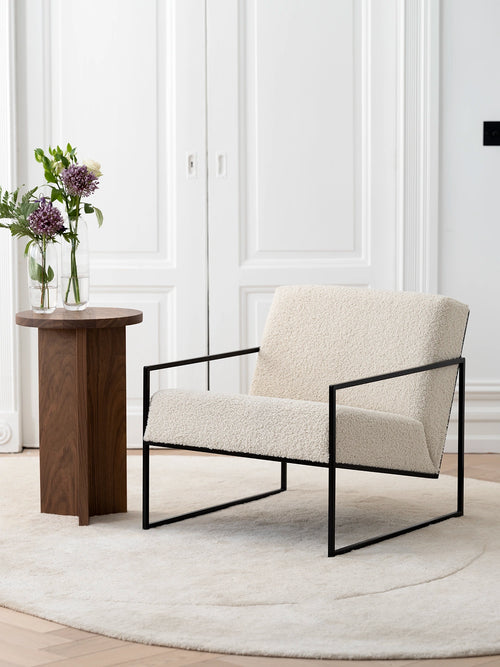
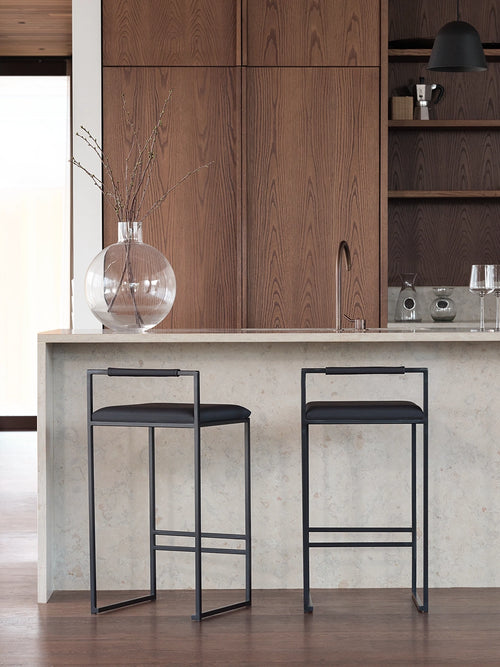
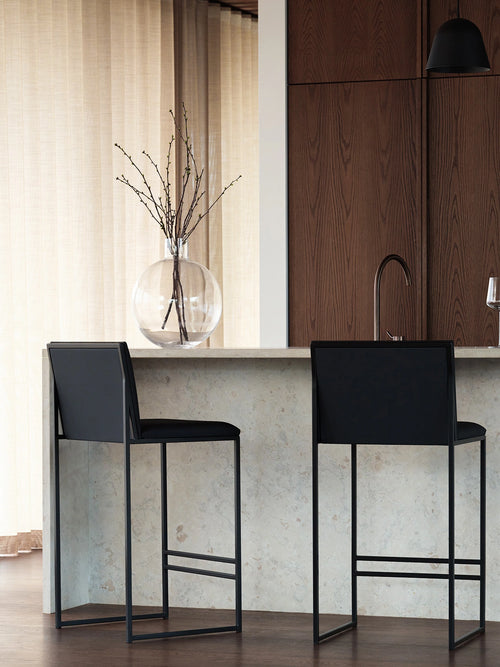
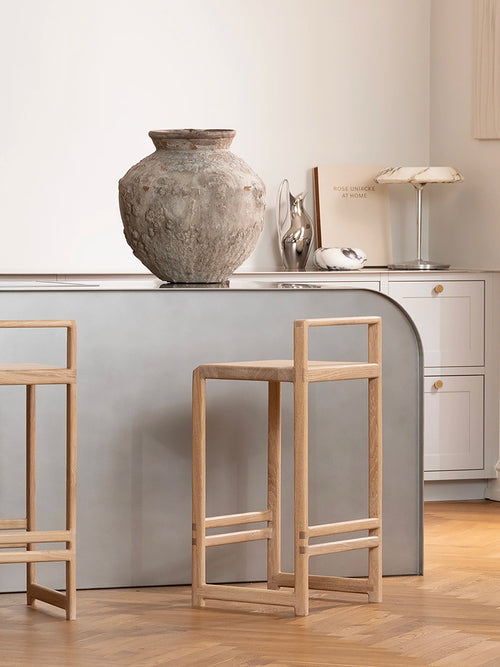
This image shows 10 Ebba barstools from by Crea in dark stained oak in a Dark oak minimalistic kitchen with contemporary light stone marble top.
Image Link

Backrest height affects posture, support duration, and how a stool is used.This guide explains backrest height with clear ergonomic rules and exact measurements.The goal is to help you choose a stool that fits your counter and your sitting time.No assumptions are required.

Backrest height affects posture, support duration, and how a stool is used.This guide explains backrest height with clear ergonomic rules and exact measurements.The goal is to help you choose a stool that fits your counter and your sitting time.No assumptions are required.

1. What backrest height means in practical use

Backrest height is the vertical distance from the seat surface to the top of the back support.It determines how much of the lower or upper back is supported while sitting.Low backrests stabilise posture without restricting movement.Higher backrests increase support during longer seating sessions.A stool without a backrest relies on core balance and foot support.Backrest height does not change seat height.Backrest height affects comfort and posture, not counter fit.

Backrest height is the vertical distance from the seat surface to the top of the back support.It determines how much of the lower or upper back is supported while sitting.Low backrests stabilise posture without restricting movement.Higher backrests increase support during longer seating sessions.A stool without a backrest relies on core balance and foot support.Backrest height does not change seat height.Backrest height affects comfort and posture, not counter fit.

See more See more
Bar Stool Svea in black with ivory bouclé fabric beside a modern marble kitchen island. Bar Stool Svea in black with ivory bouclé fabric beside a modern marble kitchen island.

2. Low backrest stools: support without bulk

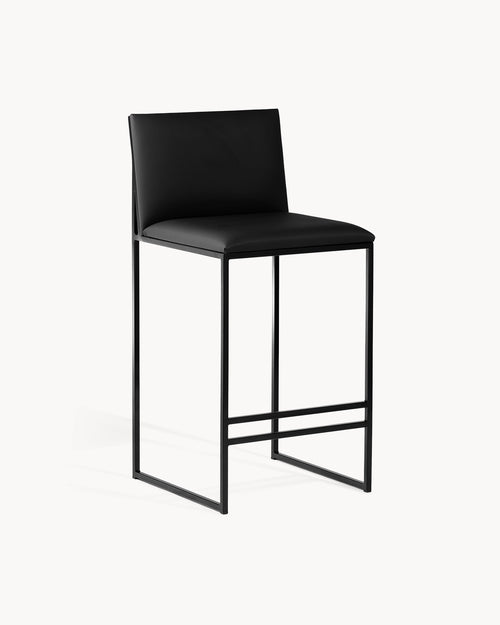
Low backrests typically support the lower back only.They provide posture stability without leaning the body backward.This type of backrest works well for kitchen islands used for short meals or coffee.Movement in and out of the stool remains easy.Visual impact stays minimal in open kitchens.Typical characteristics of low backrest stools✓ Support zone: lower back only✓ Sitting duration comfort: short to medium✓ Visual presence: low✓ Ease of movement: highLow backrest designs are common in minimalist and Scandinavian kitchens.See examples with a defined but compact backrest in the bar stool collectionhttps://www.by-crea.com/collections/barstools

Low backrests typically support the lower back only.They provide posture stability without leaning the body backward.This type of backrest works well for kitchen islands used for short meals or coffee.Movement in and out of the stool remains easy.Visual impact stays minimal in open kitchens.Typical characteristics of low backrest stools✓ Support zone: lower back only✓ Sitting duration comfort: short to medium✓ Visual presence: low✓ Ease of movement: highLow backrest designs are common in minimalist and Scandinavian kitchens.See examples with a defined but compact backrest in the bar stool collectionhttps://www.by-crea.com/collections/barstools

See furniture See furniture

3. Higher backrest stools: comfort for longer sitting

Higher backrests extend support further up the back.They reduce muscle effort during longer sitting periods.This matters in kitchens where stools replace dining chairs.Higher backrests encourage a more relaxed seated posture.They also reduce fatigue during work, meals, or social use.Typical characteristics of higher backrest stools✓ Support zone: lower and mid back✓ Sitting duration comfort: medium to long✓ Visual presence: higher✓ Ease of movement: moderateStools with higher backrests are often preferred in family kitchens and hospitality settings.Compare a higher backrest design such as Philiphttps://by-crea.com/products/philip-barstool-black-frame-jade-black-leather

Higher backrests extend support further up the back.They reduce muscle effort during longer sitting periods.This matters in kitchens where stools replace dining chairs.Higher backrests encourage a more relaxed seated posture.They also reduce fatigue during work, meals, or social use.Typical characteristics of higher backrest stools✓ Support zone: lower and mid back✓ Sitting duration comfort: medium to long✓ Visual presence: higher✓ Ease of movement: moderateStools with higher backrests are often preferred in family kitchens and hospitality settings.Compare a higher backrest design such as Philiphttps://by-crea.com/products/philip-barstool-black-frame-jade-black-leather

Explore Counter Stools Explore Counter Stools
Freja bar stool by by Crea, black frame and black leather seat, Scandinavian kitchen island seating in a minimalist home. Ebba Bar Stools in dark oak with minimal Scandinavian design, placed at a statement kitchen island in dramatic veined marble, complemented by rich wood cabinetry and herringbone oak flooring.

4. Backrest height vs sitting time

Backrest height should match how long the stool is used at a time.Short sitting periods do not require extensive back support.Long sitting periods benefit from a higher backrest.This rule applies regardless of seat height or counter height.Sitting time guidance by backrest type✓ Under 15 minutes: no backrest or low backrest✓ 15–30 minutes: low backrest✓ Over 30 minutes: higher backrestChoosing more backrest than needed increases visual weight without improving comfort.Choosing too little backrest increases fatigue during long use.

Backrest height should match how long the stool is used at a time.Short sitting periods do not require extensive back support.Long sitting periods benefit from a higher backrest.This rule applies regardless of seat height or counter height.Sitting time guidance by backrest type✓ Under 15 minutes: no backrest or low backrest✓ 15–30 minutes: low backrest✓ Over 30 minutes: higher backrestChoosing more backrest than needed increases visual weight without improving comfort.Choosing too little backrest increases fatigue during long use.

Explore Bar Stools Explore Bar Stools
Eva Bar stools in black oak at a modern kitchen island with marble countertop, showcasing clean lines and a slim profile. Svea bar stools with black frame and latte leather seat, minimalistic design for modern kitchen or dining area.

5. Backrest height does not affect counter fit

Backrest height is independent from seat height selection.Seat height is determined by counter height only.Backrest height is chosen after seat height is correct.Standard ergonomic seat height rules still apply.Seat height rules for kitchen counters✓ 90 cm counter height: 66 cm seat height (26 in)✓ 100–110 cm counter height: 76 cm seat height (30 in)Backrest height should never be used to compensate for incorrect seat height.If seat height is wrong, back support cannot fix discomfort.

Backrest height is independent from seat height selection.Seat height is determined by counter height only.Backrest height is chosen after seat height is correct.Standard ergonomic seat height rules still apply.Seat height rules for kitchen counters✓ 90 cm counter height: 66 cm seat height (26 in)✓ 100–110 cm counter height: 76 cm seat height (30 in)Backrest height should never be used to compensate for incorrect seat height.If seat height is wrong, back support cannot fix discomfort.

Explore Freja Counter Stool Explore Freja Counter Stool

6. Backrest height and space planning

Backrest height affects how stools interact with surrounding space.Higher backrests occupy more visual and physical volume.They may block sightlines in open kitchens.Low backrests keep kitchens visually open.This matters especially in small or narrow layouts.Space considerations by backrest type✓ Small kitchens: low backrest or no backrest✓ Open plan kitchens: low to mid backrest✓ Dedicated seating areas: higher backrest acceptableBackrest choice should consider room depth, island length, and walkway clearance.

Backrest height affects how stools interact with surrounding space.Higher backrests occupy more visual and physical volume.They may block sightlines in open kitchens.Low backrests keep kitchens visually open.This matters especially in small or narrow layouts.Space considerations by backrest type✓ Small kitchens: low backrest or no backrest✓ Open plan kitchens: low to mid backrest✓ Dedicated seating areas: higher backrest acceptableBackrest choice should consider room depth, island length, and walkway clearance.

Bar Stool Freja in black frame, black leather cushion, and brown backrest at a modern kitchen island. Bar Stool Freja in black frame, black leather cushion, and brown backrest at a modern kitchen island.

7. Backrest height and material interaction

Backrest height interacts with material stiffness and upholstery.Rigid materials feel firmer at the same height.Upholstered backrests feel softer at the same height.A higher backrest in steel without upholstery can feel harder.A lower upholstered backrest can feel equally supportive.Material considerations✓ Steel frame with upholstery: effective support at lower heights✓ Solid wood without upholstery: benefits from slightly higher backrest✓ Upholstered backrest: distributes pressure more evenlyMaterial choice should be evaluated together with backrest height.See steel and wooden options for comparisonhttps://www.by-crea.com/collections/steel-barstoolshttps://www.by-crea.com/collections/wooden-barstools

Backrest height interacts with material stiffness and upholstery.Rigid materials feel firmer at the same height.Upholstered backrests feel softer at the same height.A higher backrest in steel without upholstery can feel harder.A lower upholstered backrest can feel equally supportive.Material considerations✓ Steel frame with upholstery: effective support at lower heights✓ Solid wood without upholstery: benefits from slightly higher backrest✓ Upholstered backrest: distributes pressure more evenlyMaterial choice should be evaluated together with backrest height.See steel and wooden options for comparisonhttps://www.by-crea.com/collections/steel-barstoolshttps://www.by-crea.com/collections/wooden-barstools

Learn about our materials Learn about our materials

8. The core rule for backrest height comfort

Backrest height should match sitting time, not counter height.Seat height matches the counter.Backrest height matches how long you sit.More backrest is not automatically more comfortable.Correct seat height plus appropriate backrest height creates comfort.

Backrest height should match sitting time, not counter height.Seat height matches the counter.Backrest height matches how long you sit.More backrest is not automatically more comfortable.Correct seat height plus appropriate backrest height creates comfort.

About us About us
Oak Bar Stool Carl in dark oak with ivory bouclé in a modern kitchen setting with marble countertops. Oak Bar Stool Carl in dark oak with ivory bouclé in a modern kitchen setting with marble countertops.

9. Backrest height decision checklist

✓ Confirm your counter height first✓ Select correct seat height based on the counter✓ Estimate typical sitting duration✓ Choose low backrest for short sitting✓ Choose higher backrest for long sitting✓ Consider visual impact in your space✓ Match backrest height with material stiffness

✓ Confirm your counter height first✓ Select correct seat height based on the counter✓ Estimate typical sitting duration✓ Choose low backrest for short sitting✓ Choose higher backrest for long sitting✓ Consider visual impact in your space✓ Match backrest height with material stiffness

Explore Counter Stools Explore Counter Stools

Conclusion

Choose seat height from the counter height first.Then choose backrest height from sitting time and space needs.For a standard 90 cm counter, a 66 cm seat height (26 in) keeps the ergonomic gap correct.A higher backrest increases comfort for longer sitting, not for better counter fit.If you are unsure between options, compare models and ask for guidance before ordering.Contacthttps://by-crea.com/pages/contact

Choose seat height from the counter height first.Then choose backrest height from sitting time and space needs.For a standard 90 cm counter, a 66 cm seat height (26 in) keeps the ergonomic gap correct.A higher backrest increases comfort for longer sitting, not for better counter fit.If you are unsure between options, compare models and ask for guidance before ordering.Contacthttps://by-crea.com/pages/contact

Counter stools & Bar stools FAQ

Is a backrest necessary on a kitchen bar stool?

A backrest is not mandatory for short sitting periods.For longer use, a backrest reduces muscle fatigue.Low backrests provide support without restricting movement.Higher backrests increase comfort for extended seating.Choose backrest height based on sitting time, not counter height.

How do I compare backrest options before ordering?

Physical comfort varies by posture and body type.Material stiffness also affects perceived support.Viewing comparable designs helps clarify differences.If uncertainty remains, request guidance via contacthttps://by-crea.com/pages/contact

Can backrest height fix an uncomfortable stool?

Backrest height cannot correct incorrect seat height.If the seat is too high or too low, discomfort remains.Correct seat height must be established first.Backrest height only fine-tunes comfort afterward.

Which backrest height is best for a kitchen island?

Kitchen islands used for quick meals suit low backrests.Islands used as dining areas suit higher backrests.Decide from daily sitting time at the island.There is no single universal backrest height.

Are backless stools uncomfortable?

Backless stools rely on core balance and foot support.They work well for short sitting and compact spaces.They are less suitable for long meals or work.Comfort depends on posture and sitting time.

Does a higher backrest make a stool more comfortable?

A higher backrest improves comfort only during longer sitting.For short use, extra height does not add benefit.Excessive backrest height can reduce flexibility when moving.Comfort increases when backrest height matches use duration.