









How to Choose Bar Stools for Your Kitchen: A Step-by-Step Guide
Choosing bar stools for a kitchen follows a sequence: height first, then material and structure, then style. Skipping to style first is the most common mistake and produces stools that look right but work wrong. The height calculation takes five minutes and eliminates the largest risk in the purchase.
Measure from the floor to the underside of the counter. Subtract 23-26 cm (9-10"). The result is the target seat height. Once height is confirmed, decide on backrest or backless based on how long you typically sit. Decide on seat material based on your kitchen use and cleaning habits. Style comes last and is the easiest part.
Browse bar stools by height, or read the specific guides on seat height and comfort factors.
Choosing bar stools for a kitchen follows a sequence: height first, then material and structure, then style. Skipping to style first is the most common mistake and produces stools that look right but work wrong. The height calculation takes five minutes and eliminates the largest risk in the purchase.
Measure from the floor to the underside of the counter. Subtract 23-26 cm (9-10"). The result is the target seat height. Once height is confirmed, decide on backrest or backless based on how long you typically sit. Decide on seat material based on your kitchen use and cleaning habits. Style comes last and is the easiest part.
Browse bar stools by height, or read the specific guides on seat height and comfort factors.
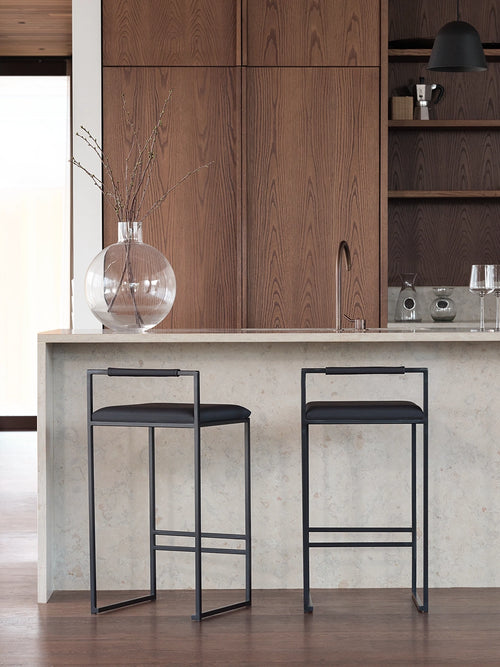
Freja bar stool at a marble island with measuring tape showing the counter underside measurement that determines the correct seat height.
Freja bar stool at a marble island with measuring tape showing the counter underside measurement that determines the correct seat height.
Philip bar stool at a marble island with the 23-26 cm legroom gap annotated showing the seat height calculation result applied to a standard 90 cm island.
Philip bar stool at a marble island with the 23-26 cm legroom gap annotated showing the seat height calculation result applied to a standard 90 cm island.
What Is the First Step in Choosing Bar Stools?
Quick reference: the measurement-first process
Step 1: measure from floor to the underside of the counter surface (not the top)
Step 2: subtract 23–26 cm from that measurement
Step 3: result 57–68 cm = counter stool; result 74–82 cm = bar stool
Why this eliminates the most common buying mistake: height cannot be adjusted after purchase
The first step is measurement. Before opening a browser or visiting a showroom, measure from the floor to the underside of your kitchen counter or island surface. This is not the top of the worktop: it is the underside, the surface that will be directly above your thighs when seated.
This measurement determines the only objective constraint in the buying decision: seat height. Every other choice is a preference. Getting the height wrong produces a stool that is uncomfortable from the first day and cannot be corrected without returning the stool. Getting it right first means every subsequent decision is purely about what you want, not what will work.
Quick reference: the measurement-first process
Step 1: measure from floor to the underside of the counter surface (not the top)
Step 2: subtract 23–26 cm from that measurement
Step 3: result 57–68 cm = counter stool; result 74–82 cm = bar stool
Why this eliminates the most common buying mistake: height cannot be adjusted after purchase
The first step is measurement. Before opening a browser or visiting a showroom, measure from the floor to the underside of your kitchen counter or island surface. This is not the top of the worktop: it is the underside, the surface that will be directly above your thighs when seated.
This measurement determines the only objective constraint in the buying decision: seat height. Every other choice is a preference. Getting the height wrong produces a stool that is uncomfortable from the first day and cannot be corrected without returning the stool. Getting it right first means every subsequent decision is purely about what you want, not what will work.
How Do You Match Seat Height to Counter Height?
Subtract 23-26 cm (9-10") from the counter underside measurement. The result is your target seat height. For most UK kitchen islands at 85-90 cm counter height, the correct seat is 60-66 cm (24-26"). For taller breakfast bars and raised counters at 100-110 cm, the correct seat is 74-76 cm (29-30").
At by Crea, the standard heights are 66 cm (26") and 76 cm (30"). These cover the majority of kitchen island and breakfast bar heights in UK and European kitchens. If your counter height is non-standard, a custom height is available across the full stool range. Do not buy a stool at a height that differs from your target by more than 2 cm: the difference in legroom is immediately noticeable in daily use.
Subtract 23-26 cm (9-10") from the counter underside measurement. The result is your target seat height. For most UK kitchen islands at 85-90 cm counter height, the correct seat is 60-66 cm (24-26"). For taller breakfast bars and raised counters at 100-110 cm, the correct seat is 74-76 cm (29-30").
At by Crea, the standard heights are 66 cm (26") and 76 cm (30"). These cover the majority of kitchen island and breakfast bar heights in UK and European kitchens. If your counter height is non-standard, a custom height is available across the full stool range. Do not buy a stool at a height that differs from your target by more than 2 cm: the difference in legroom is immediately noticeable in daily use.
Freja low-back bar stool and Svea backless bar stool side by side showing the backrest decision: low back for 30-minute use, backless for compact kitchens.
Freja low-back bar stool and Svea backless bar stool side by side showing the backrest decision: low back for 30-minute use, backless for compact kitchens.
Freja bar stool in vegan leather seat close-up and Freja in velvet close-up showing the material decision between easy-clean and soft-touch upholstery.
Freja bar stool in vegan leather seat close-up and Freja in velvet close-up showing the material decision between easy-clean and soft-touch upholstery.
How Do You Decide Between Backrest and Backless?
The backrest decision is primarily about sitting duration, not aesthetics. Ask yourself how long you typically sit at the kitchen island. If the honest answer is under 20 minutes for most uses, a backless stool is practical and comfortable. If you regularly sit for 30 minutes or more, a backrest makes a measurable difference to comfort and fatigue.
Consider also whether the stools need to tuck under the counter when not in use. In a compact kitchen where the stools would otherwise protrude into a walkway, a backless design is the functional choice regardless of sitting duration. Low-backrest stools tuck partially under the counter and offer a middle ground. Check the specific tuck-under depth of any stool you are considering against your counter overhang measurement before buying.
The backrest decision is primarily about sitting duration, not aesthetics. Ask yourself how long you typically sit at the kitchen island. If the honest answer is under 20 minutes for most uses, a backless stool is practical and comfortable. If you regularly sit for 30 minutes or more, a backrest makes a measurable difference to comfort and fatigue.
Consider also whether the stools need to tuck under the counter when not in use. In a compact kitchen where the stools would otherwise protrude into a walkway, a backless design is the functional choice regardless of sitting duration. Low-backrest stools tuck partially under the counter and offer a middle ground. Check the specific tuck-under depth of any stool you are considering against your counter overhang measurement before buying.
How Do You Choose Bar Stool Material for Your Kitchen?
Seat material choice comes down to three factors: how the kitchen is used, how you clean, and how important touch comfort is relative to maintenance. In a kitchen where food and liquids are present at every sitting, vegan leather is the easiest material to maintain. It wipes clean, resists penetration, and its performance does not degrade with regular cleaning.
Velvet and bouclé are warmer in appearance and softer on contact, but require more attentive cleaning and are less suited to daily spill exposure. Solid wood seats are easy to clean but offer no cushioning. If you have young children, vegan leather simplifies daily maintenance significantly. If the kitchen is used mainly for lighter use and cleaning is consistent, velvet or bouclé are practical choices.
Seat material choice comes down to three factors: how the kitchen is used, how you clean, and how important touch comfort is relative to maintenance. In a kitchen where food and liquids are present at every sitting, vegan leather is the easiest material to maintain. It wipes clean, resists penetration, and its performance does not degrade with regular cleaning.
Velvet and bouclé are warmer in appearance and softer on contact, but require more attentive cleaning and are less suited to daily spill exposure. Solid wood seats are easy to clean but offer no cushioning. If you have young children, vegan leather simplifies daily maintenance significantly. If the kitchen is used mainly for lighter use and cleaning is consistent, velvet or bouclé are practical choices.
How Do You Decide How Many Bar Stools You Need?
Stool count follows from island edge length. Measure the total seated edge length. Subtract 15-20 cm at each end. Divide the remaining length by 55 cm for a comfortable stool count, or by 50 cm for the tight-fit maximum.
A 120 cm island fits 2 stools comfortably. A 180 cm island fits 3. A 240 cm island fits 4. Resist the temptation to fit one more stool than the calculation supports. An island with two well-spaced stools that people choose to sit at is more functional than an island with three stools that feels crowded. Read the full guide on how many bar stools you need for the complete method.
Stool count follows from island edge length. Measure the total seated edge length. Subtract 15-20 cm at each end. Divide the remaining length by 55 cm for a comfortable stool count, or by 50 cm for the tight-fit maximum.
A 120 cm island fits 2 stools comfortably. A 180 cm island fits 3. A 240 cm island fits 4. Resist the temptation to fit one more stool than the calculation supports. An island with two well-spaced stools that people choose to sit at is more functional than an island with three stools that feels crowded. Read the full guide on how many bar stools you need for the complete method.
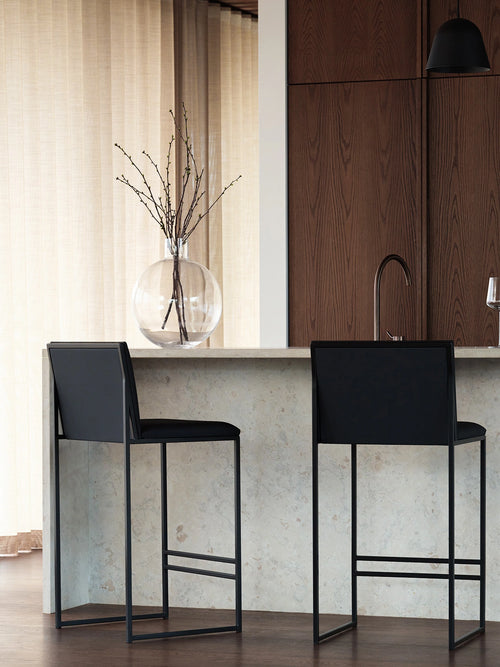
Freja black leather stools at a marble island and Ebba oak stools at a pale kitchen showing the style decision: steel frame for contemporary, oak for warm natural schemes.
Freja black leather stools at a marble island and Ebba oak stools at a pale kitchen showing the style decision: steel frame for contemporary, oak for warm natural schemes.
Philip bar stool at a marble island with a cost-per-year calculation diagram showing the long-term value of quality seating versus cheaper replaceable alternatives.
Philip bar stool at a marble island with a cost-per-year calculation diagram showing the long-term value of quality seating versus cheaper replaceable alternatives.
How Do You Match Bar Stools to Your Kitchen Style?
Style matching is the last decision, and it is the one most people make first. Once height, backrest, material, and count are determined, the remaining style choices are frame colour, upholstery colour, and overall aesthetic direction.
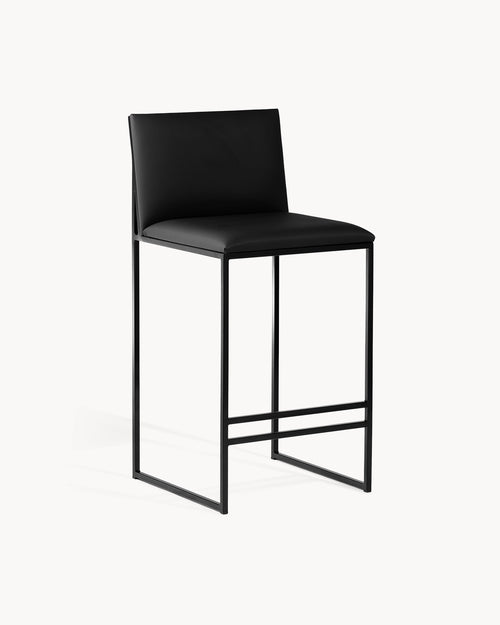
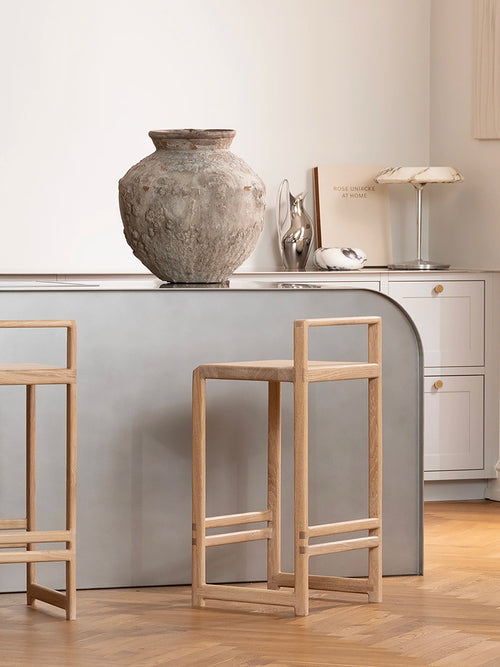
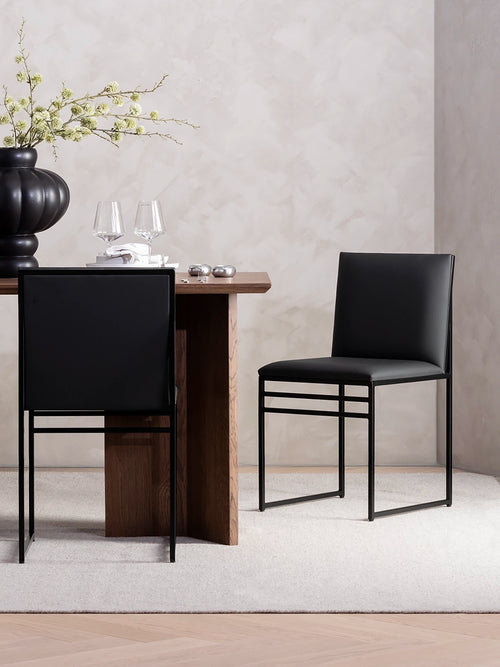
For kitchen islands with stone or quartz surfaces, a steel frame in black or warm brushed tones coordinates with the material precision. For timber or wood-effect kitchens, oak or warm-toned upholstery maintains material consistency. For light and open kitchens, pale upholstery or natural oak keeps the room from feeling heavy. For darker kitchen schemes, a contrasting seat colour on a dark frame creates depth without adding colour noise. See the guide on black bar stools and oak bar stools for specific style guidance.
Style matching is the last decision, and it is the one most people make first. Once height, backrest, material, and count are determined, the remaining style choices are frame colour, upholstery colour, and overall aesthetic direction.
For kitchen islands with stone or quartz surfaces, a steel frame in black or warm brushed tones coordinates with the material precision. For timber or wood-effect kitchens, oak or warm-toned upholstery maintains material consistency. For light and open kitchens, pale upholstery or natural oak keeps the room from feeling heavy. For darker kitchen schemes, a contrasting seat colour on a dark frame creates depth without adding colour noise. See the guide on black bar stools and oak bar stools for specific style guidance.
What Is a Realistic Budget for Quality Bar Stools?
Quality bar stools that will perform well in daily kitchen use for a decade or more typically start at 250-400 GBP per stool. Below this range, compromises in foam density, frame construction, or surface finish begin to affect durability and comfort within three to five years.
A stool at 350 GBP that lasts fifteen years costs approximately 23 GBP per year. A stool at 120 GBP that requires replacement after four years costs 30 GBP per year and involves the additional cost and inconvenience of disposal and replacement. The long-term cost calculation favours quality at the point of purchase in almost every case. Budget for the stool you want to sit on in ten years, not the one that fits today's spending limit.
Quality bar stools that will perform well in daily kitchen use for a decade or more typically start at 250-400 GBP per stool. Below this range, compromises in foam density, frame construction, or surface finish begin to affect durability and comfort within three to five years.
A stool at 350 GBP that lasts fifteen years costs approximately 23 GBP per year. A stool at 120 GBP that requires replacement after four years costs 30 GBP per year and involves the additional cost and inconvenience of disposal and replacement. The long-term cost calculation favours quality at the point of purchase in almost every case. Budget for the stool you want to sit on in ten years, not the one that fits today's spending limit.
What to Confirm Before Placing a Bar Stool Order
Before confirming an order, verify five things. First: counter underside height and target seat height, confirmed against the stool specification. Second: island seated edge length and stool count against the 55 cm per stool calculation. Third: overhang depth, confirming it is at least 25 cm for knee clearance. Fourth: tuck-under clearance if backless or low-back stools are being considered.
Fifth: delivery lead time against any move-in or renovation date. At by Crea, bestsellers in standard heights ship the next working day. Custom heights and special configurations carry a production lead time of 2-5 working days for standard orders, and up to 3 weeks for non-standard heights. All stools arrive fully assembled.
Before confirming an order, verify five things. First: counter underside height and target seat height, confirmed against the stool specification. Second: island seated edge length and stool count against the 55 cm per stool calculation. Third: overhang depth, confirming it is at least 25 cm for knee clearance. Fourth: tuck-under clearance if backless or low-back stools are being considered.
Fifth: delivery lead time against any move-in or renovation date. At by Crea, bestsellers in standard heights ship the next working day. Custom heights and special configurations carry a production lead time of 2-5 working days for standard orders, and up to 3 weeks for non-standard heights. All stools arrive fully assembled.
Choosing Bar Stools Is a Sequence, Not a Shortlist
The buying process works when it follows the right order: measure first, then decide on structure, then material, then style. Reversing this sequence, starting with a stool that looks right and checking specifications afterwards, produces the most common bar stool mistakes: wrong height, wrong count, wrong material for the kitchen's use.
The measurement takes five minutes. The structural decision, backrest or backless, takes one. The material decision, given honest assessment of how the kitchen is used, takes another minute. By the time style comes into it, most of the available choices already meet every functional requirement. The style decision is then genuinely free rather than constrained by retrospective problem-solving.
At by Crea, the full stool range is available at 66 cm (26") and 76 cm (30") as standard, with custom heights available for non-standard counter heights. All stools arrive fully assembled.
Related guides
How much legroom do bar stools need?: the seat height measurement guide
How many bar stools do I need?: island length and stool count calculation
Comfortable bar stools: backrest, footrest, and seat shape explained
Browse bar stools
All bar stools: full range by height, material, and backrest type
Steel bar stools: Freja, Philip, Bruno, Svea
Wooden bar stools: Ebba, Carl, Eva, Ted
The buying process works when it follows the right order: measure first, then decide on structure, then material, then style. Reversing this sequence, starting with a stool that looks right and checking specifications afterwards, produces the most common bar stool mistakes: wrong height, wrong count, wrong material for the kitchen's use.
The measurement takes five minutes. The structural decision, backrest or backless, takes one. The material decision, given honest assessment of how the kitchen is used, takes another minute. By the time style comes into it, most of the available choices already meet every functional requirement. The style decision is then genuinely free rather than constrained by retrospective problem-solving.
At by Crea, the full stool range is available at 66 cm (26") and 76 cm (30") as standard, with custom heights available for non-standard counter heights. All stools arrive fully assembled.
Related guides
How much legroom do bar stools need?: the seat height measurement guide
How many bar stools do I need?: island length and stool count calculation
Comfortable bar stools: backrest, footrest, and seat shape explained
Browse bar stools
All bar stools: full range by height, material, and backrest type
Steel bar stools: Freja, Philip, Bruno, Svea
Wooden bar stools: Ebba, Carl, Eva, Ted
FAQ
What is the most important thing when choosing bar stools? +
Seat height is the most important single factor in bar stool selection. An incorrectly sized stool is uncomfortable from the first use regardless of design or material quality. Measure from the floor to the underside of the counter and subtract 23-26 cm to find the correct seat height before making any other choice.
How do I know what height bar stool I need? +
Measure from the floor to the underside of your counter surface, not the top. Subtract 23-26 cm (9-10"). The result is the target seat height. For a standard 90 cm kitchen island, this gives a 64-67 cm seat height. The by Crea standard of 66 cm (26") fits this counter range. For 100-110 cm counters, use 76 cm (30").
Should I choose a backrest or backless bar stool? +
Choose based on typical sitting duration. For sittings under 20 minutes, backless stools work well and tuck under the counter to free floor space. For 30 minutes or more, a low or high backrest makes the seated position sustainable. In compact kitchens where walkway space is limited, a backless or tuck-under design is the practical choice regardless of duration.
How many bar stools do I need for a kitchen island? +
Measure the seated island edge length, subtract 15-20 cm at each end, and divide by 55 cm. A 120 cm island fits 2 stools. A 180 cm island fits 3. A 240 cm island fits 4. Always round down rather than fitting more stools than the calculation supports.
What is the best seat material for a kitchen bar stool? +
For a working kitchen with daily food and liquid contact, vegan leather is the most practical seat material. It wipes clean, resists spills, and maintains its surface quality over years of use. Velvet and bouclé are softer and warmer in appearance but require more careful maintenance. Solid wood is easy to clean but offers no cushioning.
How much should I spend on bar stools? +
Quality bar stools for daily kitchen use start at 250-400 GBP per stool. Below this range, foam density, frame construction, and surface finish tend to be compromised. A 350 GBP stool lasting 15 years costs 23 GBP per year. A 120 GBP stool requiring replacement after four years costs 30 GBP per year, plus the inconvenience of replacement. Budget for longevity rather than initial price.