

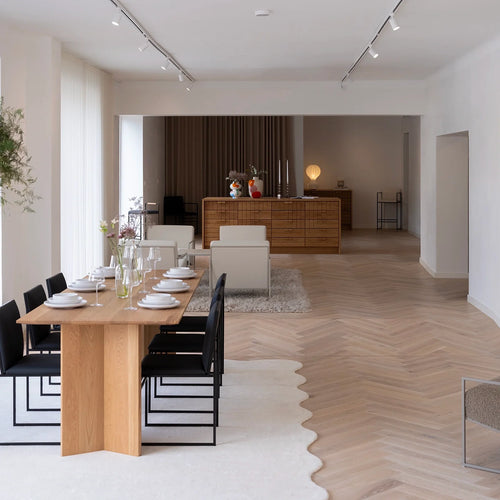

We never call our tops marble, marble effect or marble look, because they are none of those. If the word marble on the receipt matters to you, buy marble. If you want a stone top that takes a mug, a glass of wine and a wet cloth, read on.
Is Dekton marble?
No. Marble is a natural stone, cut from a quarry, with veins that make every slab different. Dekton is sintered: minerals fired under heat and pressure into a dense slab. It is not quarried, it is not a marble print and it is not a film.
Marble vs Dekton: what changes at home?
The short version: marble is beautiful and asks for care. Dekton asks for a damp cloth. Neither is indestructible: a hard point impact can chip the edge of any stone, ours included.
| Marble | Dekton (our tops) | |
|---|---|---|
| What it is | Natural stone from a quarry | Sintered stone: minerals fired into a dense slab |
| Lemon, wine, vinegar | Acid etches dull marks into the surface | Wipes off, no etching |
| Coffee and oil | Porous: soaks in unless sealed | Non-porous: sits on top, wipe it |
| Sealing | Resealed over the years | Never |
| Outdoors | Weathers and etches in rain | No fading in sun, no frost cracks |
| Pattern | Veins, every slab unique | Sabbia, Grigio, Grafite: calm, even colour |
| With age | Builds a patina of rings and etches | No patina to manage |
Why are our tops Dekton and not marble?
Because a coffee table and a dining table are used, not just looked at. Mugs, plates, keys, a lemon slice, a child's juice. On marble each of those is a decision. On sintered stone it is a wipe.
The second reason is outdoors. The same stone sits on our garden tables and benches through rain, sun and frost, which marble would not survive in good shape. One material across the house and the garden keeps the care the same: no sealer, no special cleaner. We weld the frames in Sweden and cover them for 10 years; the top has to keep up.
Which of our tables have a Dekton top?
Coffee tables: Anton, rectangular, 100 x 75 cm and smaller, and Leo, round, ø70, ø80 and ø95 cm, indoors and in the garden.
Dining: Diana in Grafite, Grigio or Sabbia, 160, 240 or 280 cm long, and Diana garden outside. More on dining tops in the dining table materials guide.
Bedside and side: Iris has a Dekton top option. Next to a sofa, Leo Small at ø70 cm works as a stone side table.
Garden: Wilma garden has a Dekton seat, and the outdoor Anton and Leo nest like the indoor ones. See the stone garden table guide.
Travertine, ceramic and marble look: same question?
Travertine is also a natural, calcium-based stone, with small holes that are usually filled. It reacts to acid the way marble does, so the same care applies.
Ceramic is a different family: in many shops sintered and porcelain tops are sold as ceramic. The question to ask is whether the pattern is printed. A lot of marble-look and travertine-look tops are a print on a ceramic or laminate face. We never sell a top as marble or travertine. On our coffee and dining tables the stone comes in three plain mineral shades: Sabbia (sandy beige), Grigio (mid grey) and Grafite (near-black).
When is marble the better buy?
When you want veining, natural variation and a surface that changes with you, and you accept that rings and etches become part of it. A marble console or a side table that holds a lamp and a book is a good use of it.
Then buy it from a stone specialist and follow their sealing advice. We are not that shop. If what you wanted was a light stone, look at Sabbia; a dark one, Grafite. Order the samples before you choose a top.
Marble for the veins, Dekton for daily use
- Marble
- veins, patina, sealing, etches
- Dekton
- wipe clean, no sealer, all year outside
- Our stone tables
- Anton, Leo, Diana, Iris, Wilma garden


