Din varukorg är tom
Ännu inga favoriter – börja utforska våra produkter!
Planning kitchen island seating correctly prevents the most common and most expensive furniture mistakes. The four variables that determine everything are: counter height, island edge length, overhang depth, and how many people need to sit. Each one has a fixed calculation method.
Standard kitchen islands sit at 85-95 cm (33-37"), which requires a 60-66 cm (24-26") seat height. Allow 50-55 cm (20-22") of island edge per stool, leave 20 cm of clear edge at each end, and confirm the island overhang is at least 25-30 cm (10-12") to allow knee clearance. Getting all four right means the seating works on day one and every day after.
Browse bar stools by height, or read the full guide on legroom and seat height.
Planning kitchen island seating correctly prevents the most common and most expensive furniture mistakes. The four variables that determine everything are: counter height, island edge length, overhang depth, and how many people need to sit. Each one has a fixed calculation method.
Standard kitchen islands sit at 85-95 cm (33-37"), which requires a 60-66 cm (24-26") seat height. Allow 50-55 cm (20-22") of island edge per stool, leave 20 cm of clear edge at each end, and confirm the island overhang is at least 25-30 cm (10-12") to allow knee clearance. Getting all four right means the seating works on day one and every day after.
Browse bar stools by height, or read the full guide on legroom and seat height.
Quick reference: standard kitchen island seating dimensions
Standard island height: 85–95 cm (floor to worktop surface)
Required seat height: 60–66 cm
Legroom gap: 23–26 cm (seat to counter underside)
Edge allowance per stool: 50–55 cm
End clearance: 20 cm each side
Minimum overhang depth: 25–30 cm for knee clearance
Standard kitchen islands in UK and European kitchens sit at 85-95 cm (33-37") from floor to worktop surface. This is consistent across most fitted and freestanding kitchen island designs. The seated height for this counter range is 60-66 cm (24-26"), which leaves a comfortable 23-26 cm (9-10") gap between the seat and the counter underside.
The 23-26 cm legroom gap is the core ergonomic number in kitchen island seating. Too little legroom compresses the thighs against the counter. Too much means the arms are raised above a comfortable resting position. This range accounts for natural variation in seated body proportions and is the standard used across European ergonomic guidelines for kitchen seating.
Quick reference: standard kitchen island seating dimensions
Standard island height: 85–95 cm (floor to worktop surface)
Required seat height: 60–66 cm
Legroom gap: 23–26 cm (seat to counter underside)
Edge allowance per stool: 50–55 cm
End clearance: 20 cm each side
Minimum overhang depth: 25–30 cm for knee clearance
Standard kitchen islands in UK and European kitchens sit at 85-95 cm (33-37") from floor to worktop surface. This is consistent across most fitted and freestanding kitchen island designs. The seated height for this counter range is 60-66 cm (24-26"), which leaves a comfortable 23-26 cm (9-10") gap between the seat and the counter underside.
The 23-26 cm legroom gap is the core ergonomic number in kitchen island seating. Too little legroom compresses the thighs against the counter. Too much means the arms are raised above a comfortable resting position. This range accounts for natural variation in seated body proportions and is the standard used across European ergonomic guidelines for kitchen seating.
The standard spacing between kitchen island stools is 50-55 cm (20-22") of island edge per seated person. This figure covers seat width plus elbow room on each side. At 55 cm per stool, seated users can comfortably reach across to a plate, turn slightly to talk, and shift position without bumping their neighbour.
At 50 cm per stool, the seating is functional but slightly tighter: practical for children or for households where the island is used for quick meals rather than extended seated time. The choice between 50 and 55 cm depends on how the kitchen island is typically used and how often all seats are occupied simultaneously.
The standard spacing between kitchen island stools is 50-55 cm (20-22") of island edge per seated person. This figure covers seat width plus elbow room on each side. At 55 cm per stool, seated users can comfortably reach across to a plate, turn slightly to talk, and shift position without bumping their neighbour.
At 50 cm per stool, the seating is functional but slightly tighter: practical for children or for households where the island is used for quick meals rather than extended seated time. The choice between 50 and 55 cm depends on how the kitchen island is typically used and how often all seats are occupied simultaneously.
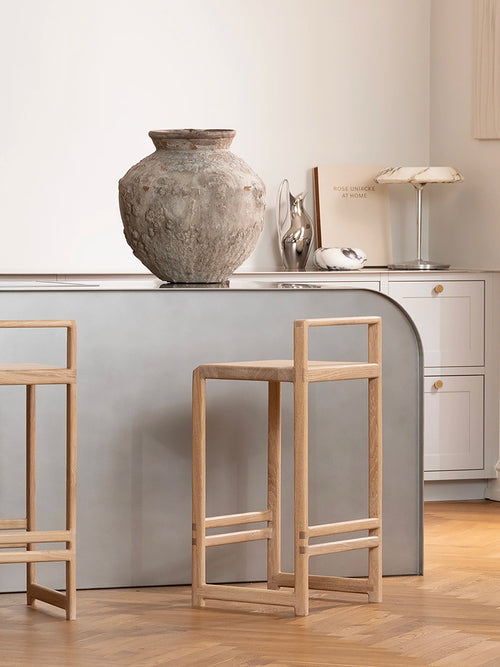
Ebba oak stool beneath a pale kitchen island overhang with the 30 cm overhang measurement annotated showing minimum knee clearance depth.
Ebba oak stool beneath a pale kitchen island overhang with the 30 cm overhang measurement annotated showing minimum knee clearance depth.
The island overhang is the depth of the counter surface that extends beyond the base cabinet or support structure below. This overhang is what provides knee clearance for seated users. The minimum overhang for comfortable seating is 25 cm (10"). At this depth, knees clear the cabinet face with some room to spare.
For comfortable long-term seated use, 30-40 cm (12-16") of overhang is the practical range. Below 25 cm, most adults will find their knees touching the cabinet, which forces a leaned-back posture and causes discomfort. If your island overhang is less than 25 cm, seating at that side is not recommended regardless of stool height.
The island overhang is the depth of the counter surface that extends beyond the base cabinet or support structure below. This overhang is what provides knee clearance for seated users. The minimum overhang for comfortable seating is 25 cm (10"). At this depth, knees clear the cabinet face with some room to spare.
For comfortable long-term seated use, 30-40 cm (12-16") of overhang is the practical range. Below 25 cm, most adults will find their knees touching the cabinet, which forces a leaned-back posture and causes discomfort. If your island overhang is less than 25 cm, seating at that side is not recommended regardless of stool height.
Measure the total length of the island edge where seating will be placed. Subtract 20 cm (8") of clear edge at each end of the seating run, giving a total usable seated length. Divide by 55 cm (22") for the maximum stool count at standard comfort spacing, or by 50 cm (20") for the tight-fit maximum.
Example: A 160 cm seated island edge, minus 20 cm at each end, gives 120 cm of usable seating length. 120 divided by 55 gives 2.18, rounding down to 2 stools at standard spacing. Divided by 50 gives 2.4, still rounding to 2. For 3 stools, this island would need at least 175 cm of total seated edge.
Measure the total length of the island edge where seating will be placed. Subtract 20 cm (8") of clear edge at each end of the seating run, giving a total usable seated length. Divide by 55 cm (22") for the maximum stool count at standard comfort spacing, or by 50 cm (20") for the tight-fit maximum.
Example: A 160 cm seated island edge, minus 20 cm at each end, gives 120 cm of usable seating length. 120 divided by 55 gives 2.18, rounding down to 2 stools at standard spacing. Divided by 50 gives 2.4, still rounding to 2. For 3 stools, this island would need at least 175 cm of total seated edge.
Different island heights require different seat heights. The relationship is fixed: seat height equals counter underside height minus 23-26 cm (9-10"). Counter underside height is the worktop height minus the worktop thickness, typically 2-4 cm.
For a 90 cm island (89 cm underside at 1 cm thickness): target seat height 63-66 cm. For a 95 cm island: 69-72 cm. For a 100 cm island: 74-77 cm. For a 110 cm island: 84-87 cm. The by Crea standard heights of 66 cm (26") and 76 cm (30") cover the most common kitchen island and breakfast bar heights in UK and European kitchens. For non-standard heights, custom sizing is available.
Different island heights require different seat heights. The relationship is fixed: seat height equals counter underside height minus 23-26 cm (9-10"). Counter underside height is the worktop height minus the worktop thickness, typically 2-4 cm.
For a 90 cm island (89 cm underside at 1 cm thickness): target seat height 63-66 cm. For a 95 cm island: 69-72 cm. For a 100 cm island: 74-77 cm. For a 110 cm island: 84-87 cm. The by Crea standard heights of 66 cm (26") and 76 cm (30") cover the most common kitchen island and breakfast bar heights in UK and European kitchens. For non-standard heights, custom sizing is available.
Ebba bar stool beneath a pale kitchen worktop showing the measurement from floor to counter underside, not to the worktop surface.
Ebba bar stool beneath a pale kitchen worktop showing the measurement from floor to counter underside, not to the worktop surface.
Counter thickness affects the calculation slightly. A standard laminate or composite worktop is 3-4 cm thick. A thick stone or quartz worktop can be 2-4 cm thick at the edge, sometimes with a doubler underneath that adds further depth. The measurement that matters is always from the floor to the underside of the counter surface, not to the top.
If your counter has a thick stone edge with a visible doubler, measure to the highest point of the underside profile. This is the point that will contact a seated user's thighs first. Getting this measurement right ensures the legroom calculation is accurate. A 2 cm measurement error leads to a 2 cm legroom error, which is noticeable in daily use.
Counter thickness affects the calculation slightly. A standard laminate or composite worktop is 3-4 cm thick. A thick stone or quartz worktop can be 2-4 cm thick at the edge, sometimes with a doubler underneath that adds further depth. The measurement that matters is always from the floor to the underside of the counter surface, not to the top.
If your counter has a thick stone edge with a visible doubler, measure to the highest point of the underside profile. This is the point that will contact a seated user's thighs first. Getting this measurement right ensures the legroom calculation is accurate. A 2 cm measurement error leads to a 2 cm legroom error, which is noticeable in daily use.
Family kitchen islands have additional considerations. If children are among the regular users, stool height at the lower end of the calculated range improves foot support. Footrests positioned 25-30 cm (10-12") below the seat reduce leg fatigue for shorter users.
For a family of mixed ages, consider whether the stools will be used by both adults and children regularly. If so, a model with a replaceable cushion, such as the Freja or Carl, extends the stool's lifespan when younger users wear the cushion surface faster than adults. Seat material for family use should be wipe-clean: vegan leather is the most practical for kitchens with young children.
Family kitchen islands have additional considerations. If children are among the regular users, stool height at the lower end of the calculated range improves foot support. Footrests positioned 25-30 cm (10-12") below the seat reduce leg fatigue for shorter users.
For a family of mixed ages, consider whether the stools will be used by both adults and children regularly. If so, a model with a replaceable cushion, such as the Freja or Carl, extends the stool's lifespan when younger users wear the cushion surface faster than adults. Seat material for family use should be wipe-clean: vegan leather is the most practical for kitchens with young children.
The most common mistake is buying stools before measuring the counter underside. Even a 3 cm error in the legroom calculation produces a stool that is uncomfortable from day one. The second most common mistake is buying the wrong number of stools for the island length, resulting in either crowded seating or a visually unbalanced island.
The third mistake is choosing stools with no account for overhang depth. If the island overhang is less than 25 cm, adding seating to that side regardless of stool height creates an uncomfortable seating position. Measure overhang, counter height, and island edge length before selecting any stool. The measurements take five minutes and prevent weeks of frustration.
The most common mistake is buying stools before measuring the counter underside. Even a 3 cm error in the legroom calculation produces a stool that is uncomfortable from day one. The second most common mistake is buying the wrong number of stools for the island length, resulting in either crowded seating or a visually unbalanced island.
The third mistake is choosing stools with no account for overhang depth. If the island overhang is less than 25 cm, adding seating to that side regardless of stool height creates an uncomfortable seating position. Measure overhang, counter height, and island edge length before selecting any stool. The measurements take five minutes and prevent weeks of frustration.
Philip bar stool at a marble kitchen island with height, spacing, and overhang measurements annotated showing the three numbers that determine kitchen island seating.
Philip bar stool at a marble kitchen island with height, spacing, and overhang measurements annotated showing the three numbers that determine kitchen island seating.
Kitchen island seating decisions made after the island is installed are constrained by what is already fixed. If the counter height, overhang depth, and island edge length are determined by the kitchen design, the stool selection must work within those parameters with no flexibility.
If you are planning a new kitchen or island, build the seating calculation in from the start. A standard 90 cm counter height, 30-35 cm overhang, and island edge divisible by 55 cm gives a seating setup that works with any bar stool at 66 cm. These are the numbers that make seating feel designed rather than retrofitted.
At by Crea, standard heights are 66 cm (26") and 76 cm (30"). Custom heights covering the full 60-90 cm range are available for non-standard counter heights with a production lead time of 1-3 weeks.
Related guides
How many bar stools do I need for my kitchen island?: step-by-step calculation
How much legroom do bar stools need?: full seat height measurement guide
Best bar stools for kitchen islands: height, material, and style guide
Browse bar stools by height
All bar stools: filter by 66 cm or 76 cm standard height
Steel bar stools: Freja, Philip, Bruno, Svea
Kitchen island seating decisions made after the island is installed are constrained by what is already fixed. If the counter height, overhang depth, and island edge length are determined by the kitchen design, the stool selection must work within those parameters with no flexibility.
If you are planning a new kitchen or island, build the seating calculation in from the start. A standard 90 cm counter height, 30-35 cm overhang, and island edge divisible by 55 cm gives a seating setup that works with any bar stool at 66 cm. These are the numbers that make seating feel designed rather than retrofitted.
At by Crea, standard heights are 66 cm (26") and 76 cm (30"). Custom heights covering the full 60-90 cm range are available for non-standard counter heights with a production lead time of 1-3 weeks.
Related guides
How many bar stools do I need for my kitchen island?: step-by-step calculation
How much legroom do bar stools need?: full seat height measurement guide
Best bar stools for kitchen islands: height, material, and style guide
Browse bar stools by height
All bar stools: filter by 66 cm or 76 cm standard height
Steel bar stools: Freja, Philip, Bruno, Svea
Measure from the floor to the underside of the island counter and subtract 23-26 cm (9-10"). For a standard 90 cm island, this gives a seat height of 64-67 cm. The by Crea standard of 66 cm (26") fits most UK kitchen islands at 88-92 cm counter height. For taller islands at 100-110 cm, use a 76 cm (30") stool.
The minimum overhang for comfortable kitchen island seating is 25 cm (10"). This provides enough knee clearance for most adults. For comfortable long-term seated use, 30-40 cm (12-16") is recommended. If the overhang is under 25 cm, seating at that side of the island is not recommended.
Allow 50-55 cm (20-22") of island edge per stool for comfortable seated spacing. At 55 cm per stool, users have enough elbow room and personal space for daily meals. At 50 cm, the seating is functional but slightly tighter. Closer than 45 cm per stool is uncomfortable for regular adult use.
Yes. A kitchen island with a seated edge shorter than 80 cm cannot comfortably accommodate even one adult stool at standard spacing. Below 100 cm, two stools are tight. If seating is important, plan for a minimum 110-120 cm seated edge for two stools, and 165-170 cm for three.
Yes, slightly. A thick stone worktop of 3-4 cm reduces the clearance from the floor to the counter underside compared to a thin worktop. Always measure from floor to the underside of the counter, not to the top surface, and subtract 23-26 cm. The measurement from the underside is what matters for legroom.
A backrest does not change the overhang requirement. The key measurement is whether the seated user's knees clear the cabinet face. For both backless and backrest stools, a minimum 25 cm overhang applies. The backrest affects the stool's footprint behind the seated user, not in front.