Votre panier est vide
Small kitchen islands need stools that fit within tight spacing constraints without making the kitchen feel cramped. The minimum island width per stool is 50 cm (20"), though 55 cm (22") is more comfortable for daily use. At a minimum 23 cm (9") legroom gap, the height rule is the same regardless of island size.
Backless stools are the practical choice for small islands: they tuck fully under the counter when not in use, freeing up walkway space. Compact seat widths of 38-40 cm suit tighter layouts without sacrificing seating comfort. The Svea and Ebba stools have the smallest footprint in the by Crea range.
Browse bar stools by height and style or explore wooden bar stools for compact profiles.
Small kitchen islands need stools that fit within tight spacing constraints without making the kitchen feel cramped. The minimum island width per stool is 50 cm (20"), though 55 cm (22") is more comfortable for daily use. At a minimum 23 cm (9") legroom gap, the height rule is the same regardless of island size.
Backless stools are the practical choice for small islands: they tuck fully under the counter when not in use, freeing up walkway space. Compact seat widths of 38-40 cm suit tighter layouts without sacrificing seating comfort. The Svea and Ebba stools have the smallest footprint in the by Crea range.
Browse bar stools by height and style or explore wooden bar stools for compact profiles.
Quick reference: compact stool dimensions that work for small islands
Seat width: 35–40 cm (versus 42–48 cm for standard stools)
Seat height: counter underside minus 23–26 cm — same rule as any stool
Minimum overhang: 25 cm for knee clearance
Profile: backless + slim frame tucks fully under the counter when not in use
A small kitchen island stool must do two things well: seat correctly at the counter height and disappear visually or physically when not in use. The functional requirements are identical to any kitchen island stool: 23-26 cm (9-10") of legroom, correct seat height, and stable construction. The added constraint is physical footprint.
Stools with slim steel frames, narrow seat widths, and backless profiles take up the least space when seated and tuck fully under the counter when pushed in. These properties matter most when the island sits in an open-plan kitchen where the stools are visible from the living area and remain pushed in for most of the day.
Quick reference: compact stool dimensions that work for small islands
Seat width: 35–40 cm (versus 42–48 cm for standard stools)
Seat height: counter underside minus 23–26 cm — same rule as any stool
Minimum overhang: 25 cm for knee clearance
Profile: backless + slim frame tucks fully under the counter when not in use
A small kitchen island stool must do two things well: seat correctly at the counter height and disappear visually or physically when not in use. The functional requirements are identical to any kitchen island stool: 23-26 cm (9-10") of legroom, correct seat height, and stable construction. The added constraint is physical footprint.
Stools with slim steel frames, narrow seat widths, and backless profiles take up the least space when seated and tuck fully under the counter when pushed in. These properties matter most when the island sits in an open-plan kitchen where the stools are visible from the living area and remain pushed in for most of the day.
The standard spacing recommendation is 55 cm (22") of island width per stool, which gives comfortable elbow room for daily use. On a small island, 50 cm (20") per stool is workable, particularly for backless stools where there is no backrest adding to the visual mass.
For a 100 cm (39") island, two stools at 50 cm each are achievable. For a 90 cm island, two stools at 45 cm per stool is tight: it works for children or slim adults but feels crowded for regular adult use. If the island is under 90 cm along the seated edge, a single stool placed centrally is often the more comfortable solution.
The standard spacing recommendation is 55 cm (22") of island width per stool, which gives comfortable elbow room for daily use. On a small island, 50 cm (20") per stool is workable, particularly for backless stools where there is no backrest adding to the visual mass.
For a 100 cm (39") island, two stools at 50 cm each are achievable. For a 90 cm island, two stools at 45 cm per stool is tight: it works for children or slim adults but feels crowded for regular adult use. If the island is under 90 cm along the seated edge, a single stool placed centrally is often the more comfortable solution.
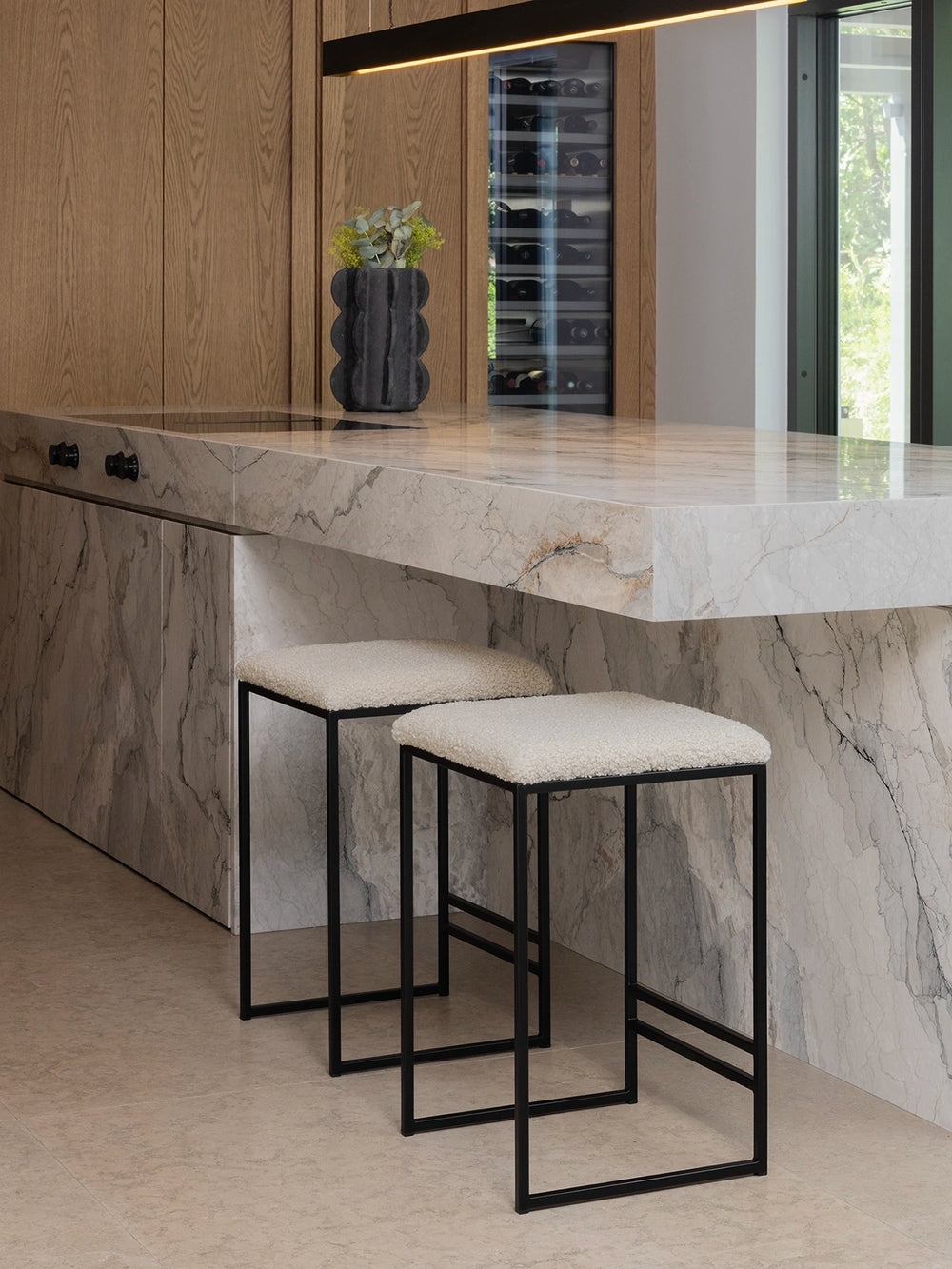
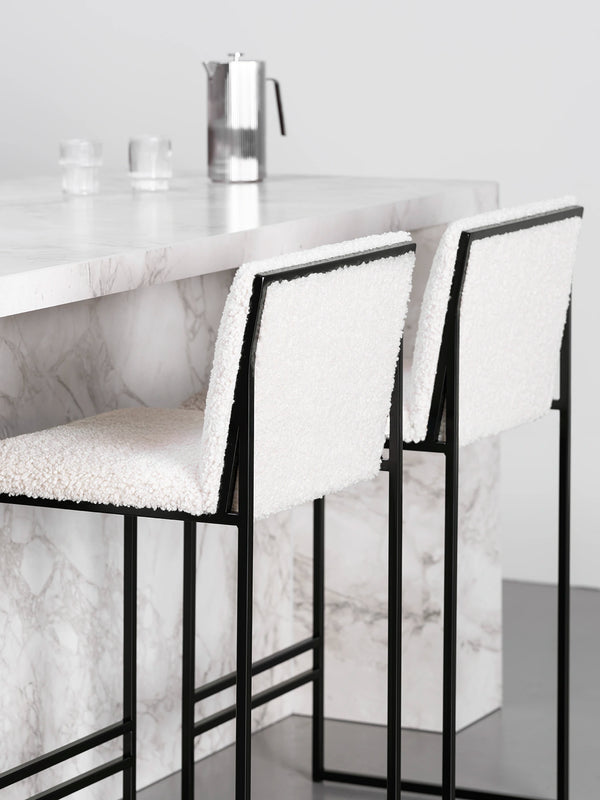
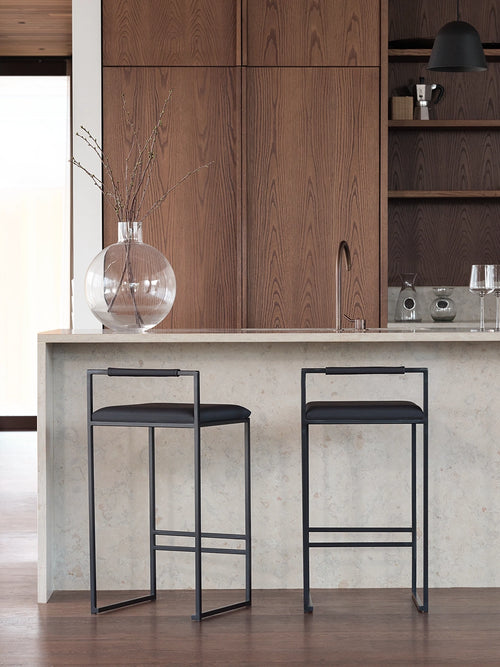
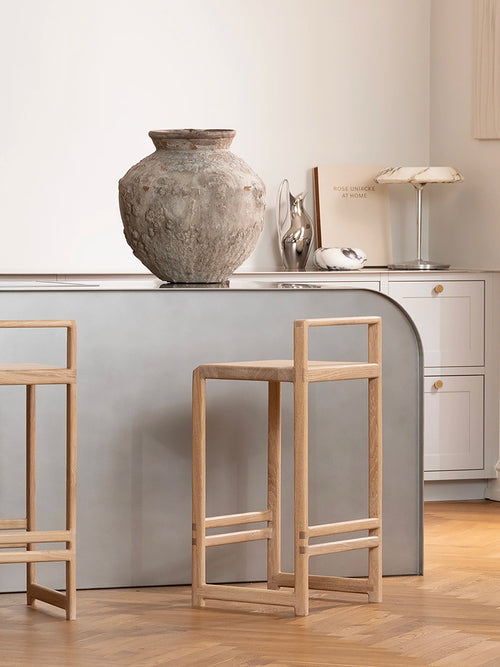
Svea backless bar stool tucked fully under a kitchen island counter showing the walkway space recovered when stools are not in use.
Backless stools offer two practical advantages for small kitchen islands. First, they tuck completely under the counter surface when not in use, reclaiming the full walkway width around the island. Second, they have a smaller visual mass than backrest stools, which makes the kitchen feel less cluttered.
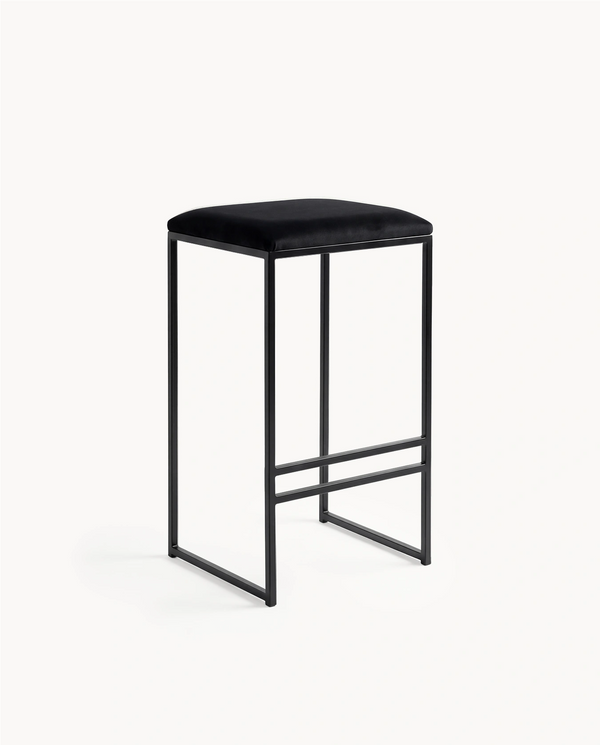
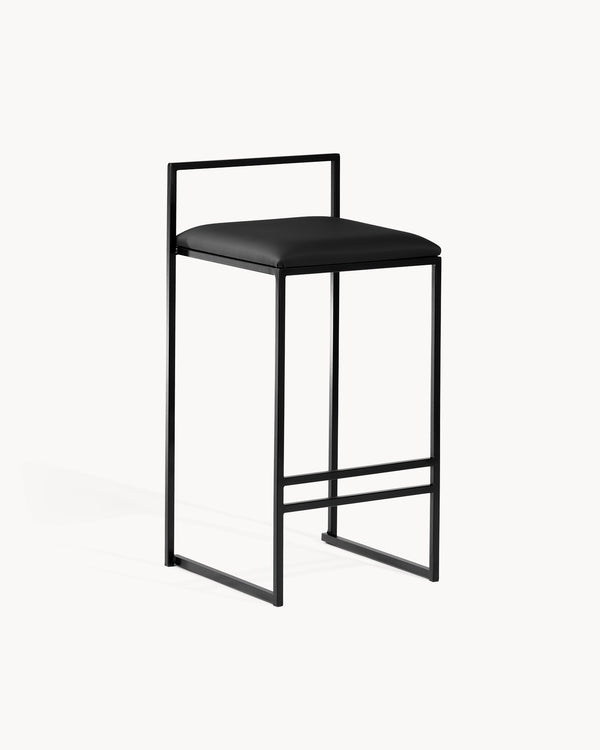
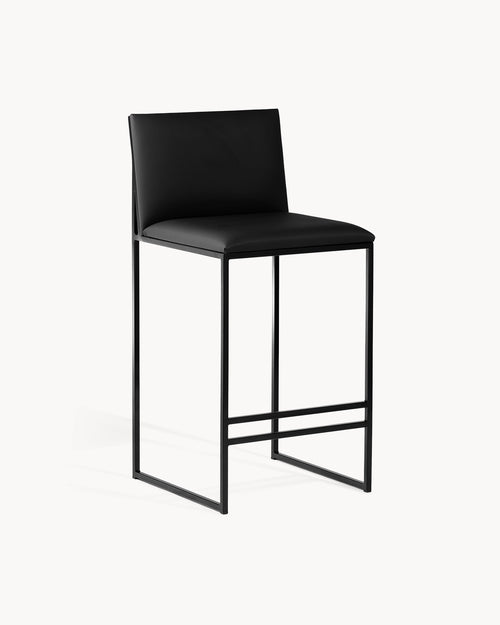
The trade-off is comfort duration. Backless stools are comfortable for 15-25 minute sitting sessions: meals, coffee, brief conversation. For households that regularly sit for 30 minutes or more at the island, a low backrest stool may be worth the additional physical footprint. The Svea stool is backless with a slim steel frame at 38 cm seat width, suited to compact island layouts.
Backless stools offer two practical advantages for small kitchen islands. First, they tuck completely under the counter surface when not in use, reclaiming the full walkway width around the island. Second, they have a smaller visual mass than backrest stools, which makes the kitchen feel less cluttered.
The trade-off is comfort duration. Backless stools are comfortable for 15-25 minute sitting sessions: meals, coffee, brief conversation. For households that regularly sit for 30 minutes or more at the island, a low backrest stool may be worth the additional physical footprint. The Svea stool is backless with a slim steel frame at 38 cm seat width, suited to compact island layouts.
Seat width is the main dimension that affects how much space a stool occupies when in use. A 38-40 cm seat width is practical for adult seating without feeling cramped. Wider seats of 44-46 cm take more island edge per stool and make the total seating run longer.
Seat depth of 38-40 cm (15-16") keeps the stool profile shallow when tucked under the counter. Slim steel legs at 12-16 mm diameter have a smaller visual mass than turned wooden legs, making the stool feel lighter in a small space. The combination of a 38 cm seat width, 40 cm seat depth, and 12 mm steel legs produces a stool that reads as minimal in a compact kitchen.
Seat width is the main dimension that affects how much space a stool occupies when in use. A 38-40 cm seat width is practical for adult seating without feeling cramped. Wider seats of 44-46 cm take more island edge per stool and make the total seating run longer.
Seat depth of 38-40 cm (15-16") keeps the stool profile shallow when tucked under the counter. Slim steel legs at 12-16 mm diameter have a smaller visual mass than turned wooden legs, making the stool feel lighter in a small space. The combination of a 38 cm seat width, 40 cm seat depth, and 12 mm steel legs produces a stool that reads as minimal in a compact kitchen.
Height accuracy is non-negotiable regardless of island size. A stool that is 4 cm too tall for your island creates discomfort from day one, and no amount of compact design compensates for incorrect legroom. Measure from the floor to the underside of the island surface and subtract 23-26 cm (9-10") to find the correct seat height.
For most kitchen islands in UK and European kitchens, the standard height is 85-95 cm (33-37"), producing a target seat height of 60-66 cm (24-26"). At by Crea, the 66 cm (26") height is the standard bestseller for this counter range. If your island sits outside this range, measure before ordering. Read how much legroom bar stools need for the full measurement method.
Height accuracy is non-negotiable regardless of island size. A stool that is 4 cm too tall for your island creates discomfort from day one, and no amount of compact design compensates for incorrect legroom. Measure from the floor to the underside of the island surface and subtract 23-26 cm (9-10") to find the correct seat height.
For most kitchen islands in UK and European kitchens, the standard height is 85-95 cm (33-37"), producing a target seat height of 60-66 cm (24-26"). At by Crea, the 66 cm (26") height is the standard bestseller for this counter range. If your island sits outside this range, measure before ordering. Read how much legroom bar stools need for the full measurement method.
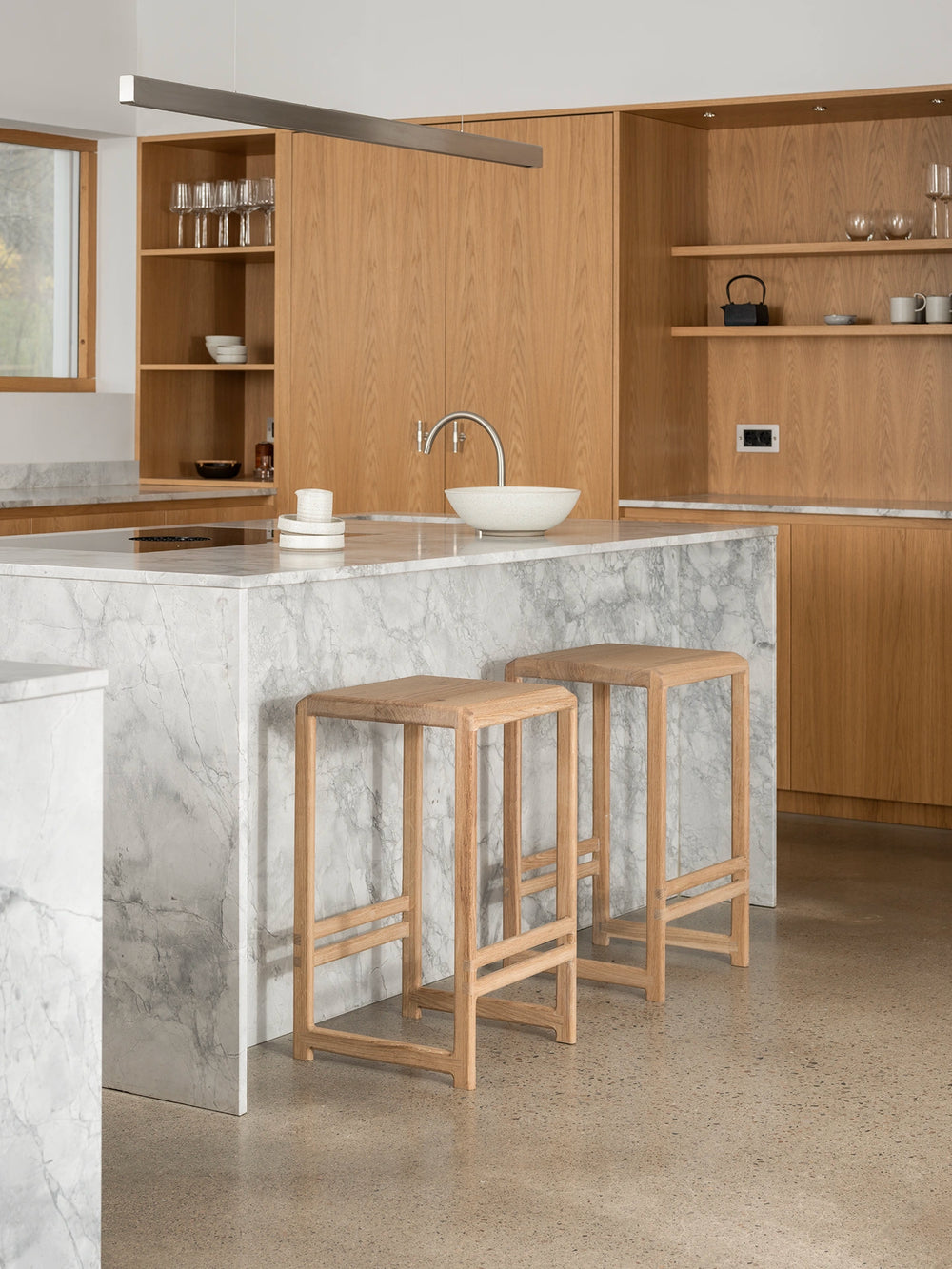
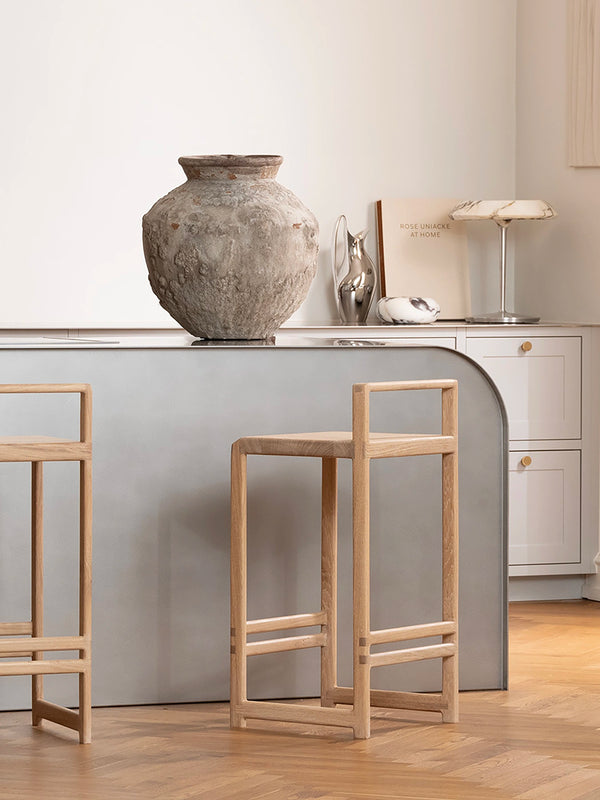
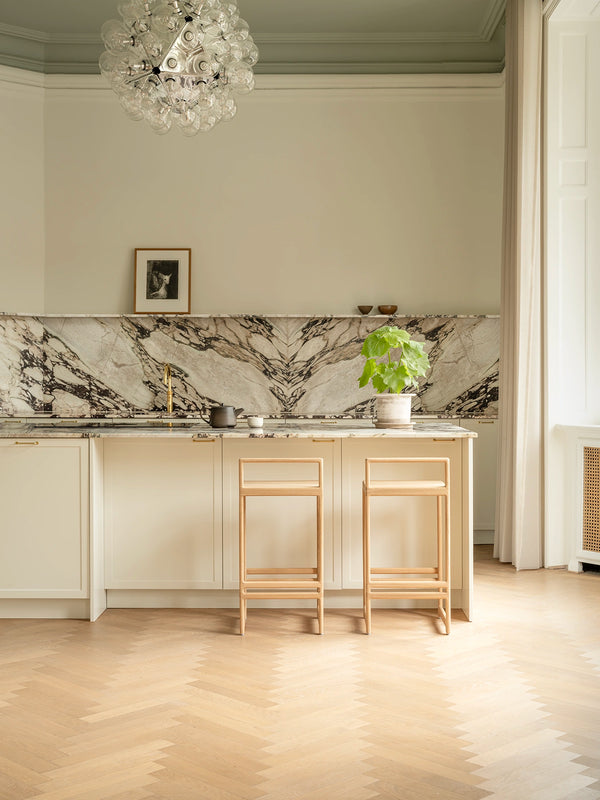
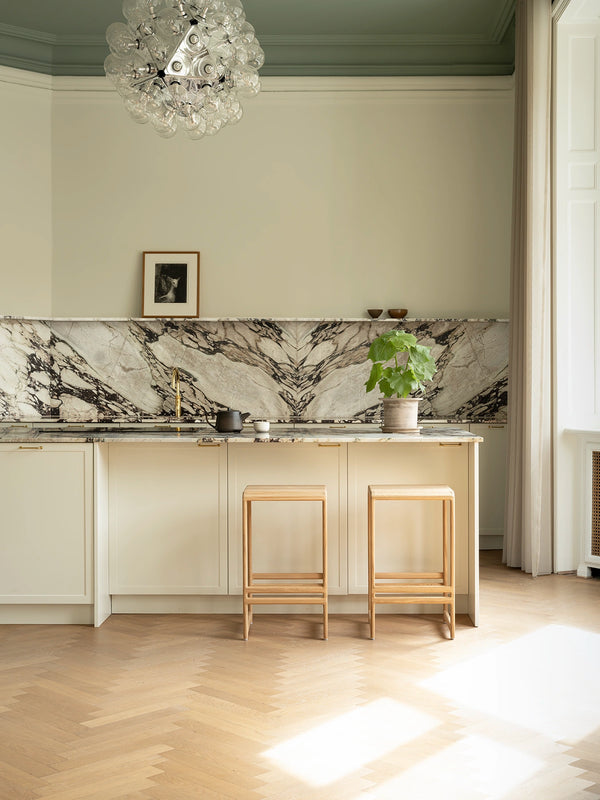
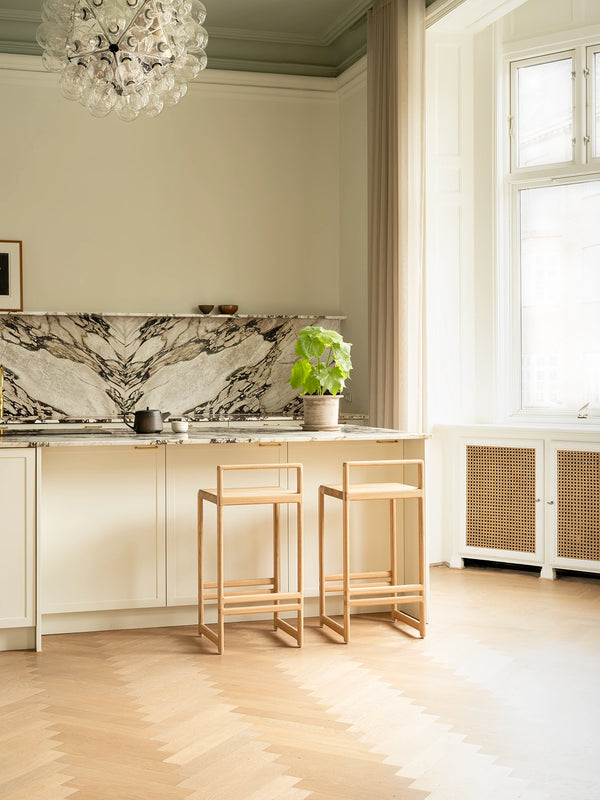
Ebba oak stools at a light kitchen showing how consistent natural wood tones reduce visual crowding in a compact open-plan kitchen.
Visual crowding in a small kitchen often comes from stool legs rather than seats. Wire-frame or thin tubular steel legs with minimal cross-bracing allow sightlines through the stool to the floor, making the space feel more open. Solid wood turned legs, particularly in darker finishes, can make a small kitchen feel heavier than it is.
Consistent stool colour also reduces visual noise. A single stool colour matched to or contrasting cleanly with the island surface is less visually demanding than a mixed palette. In small kitchens, restraint in material and colour keeps the island seating from becoming the dominant visual element in an already compact room.
Visual crowding in a small kitchen often comes from stool legs rather than seats. Wire-frame or thin tubular steel legs with minimal cross-bracing allow sightlines through the stool to the floor, making the space feel more open. Solid wood turned legs, particularly in darker finishes, can make a small kitchen feel heavier than it is.
Consistent stool colour also reduces visual noise. A single stool colour matched to or contrasting cleanly with the island surface is less visually demanding than a mixed palette. In small kitchens, restraint in material and colour keeps the island seating from becoming the dominant visual element in an already compact room.
Steel frames with slim legs work particularly well for small kitchen islands. The material allows thin structural members that do not compromise strength, which means the stool can be visually light without being physically fragile. Powder-coated steel in black or white blends easily with most kitchen colour schemes.
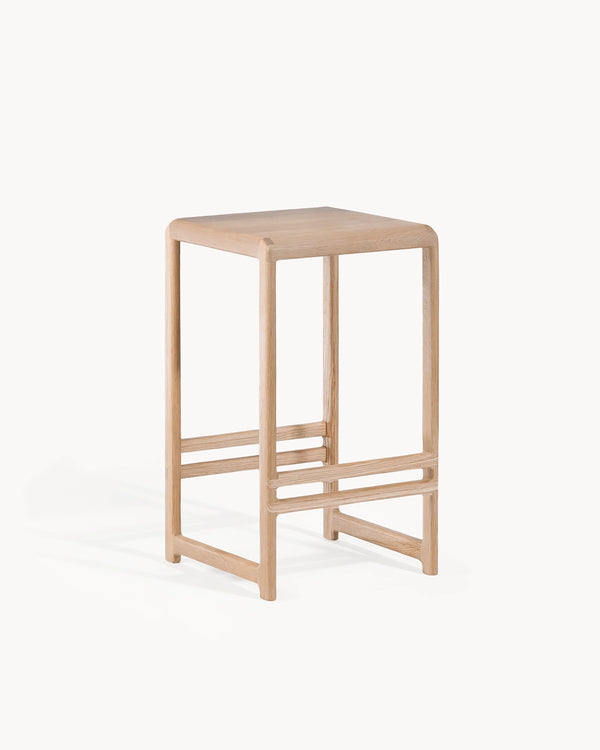
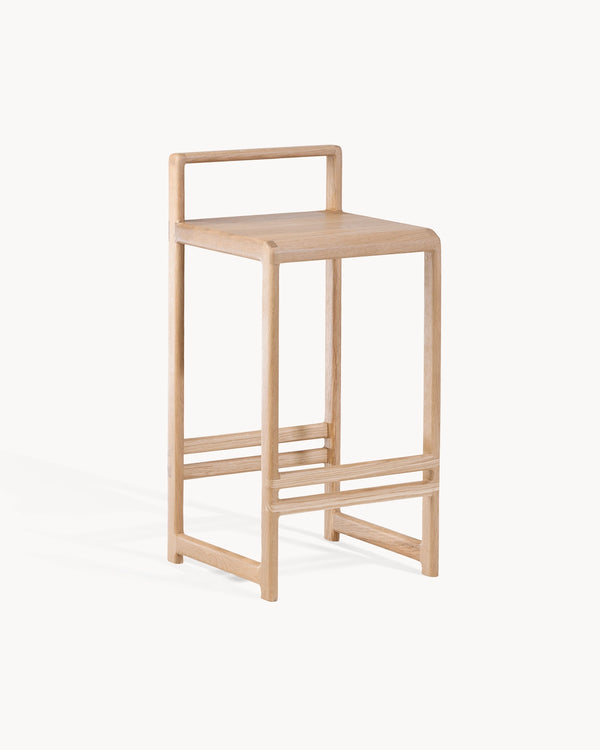
Solid oak frames have a warm visual quality that suits Scandinavian and natural-material kitchen aesthetics, but the leg sections are typically thicker than steel for equivalent strength. In very compact kitchens, an oak stool with a slim profile, such as the Ebba, is a practical compromise between warmth and minimal footprint.
Steel frames with slim legs work particularly well for small kitchen islands. The material allows thin structural members that do not compromise strength, which means the stool can be visually light without being physically fragile. Powder-coated steel in black or white blends easily with most kitchen colour schemes.
Solid oak frames have a warm visual quality that suits Scandinavian and natural-material kitchen aesthetics, but the leg sections are typically thicker than steel for equivalent strength. In very compact kitchens, an oak stool with a slim profile, such as the Ebba, is a practical compromise between warmth and minimal footprint.
The main mistake when buying stools for a small island is choosing the stool before measuring the island. A seat that is 2 cm too wide per stool on a three-stool island adds 6 cm to the total seating run, which can make the difference between a comfortable fit and an overcrowded counter.
The second most common mistake is choosing a stool with a deep backrest that cannot tuck under the counter when not in use. In compact kitchens, a stool that protrudes 30-40 cm into the walkway every time it is vacated significantly reduces the functional space. Check tuck-under clearance before buying: measure your island overhang depth and compare it to the stool's backrest height.
The main mistake when buying stools for a small island is choosing the stool before measuring the island. A seat that is 2 cm too wide per stool on a three-stool island adds 6 cm to the total seating run, which can make the difference between a comfortable fit and an overcrowded counter.
The second most common mistake is choosing a stool with a deep backrest that cannot tuck under the counter when not in use. In compact kitchens, a stool that protrudes 30-40 cm into the walkway every time it is vacated significantly reduces the functional space. Check tuck-under clearance before buying: measure your island overhang depth and compare it to the stool's backrest height.
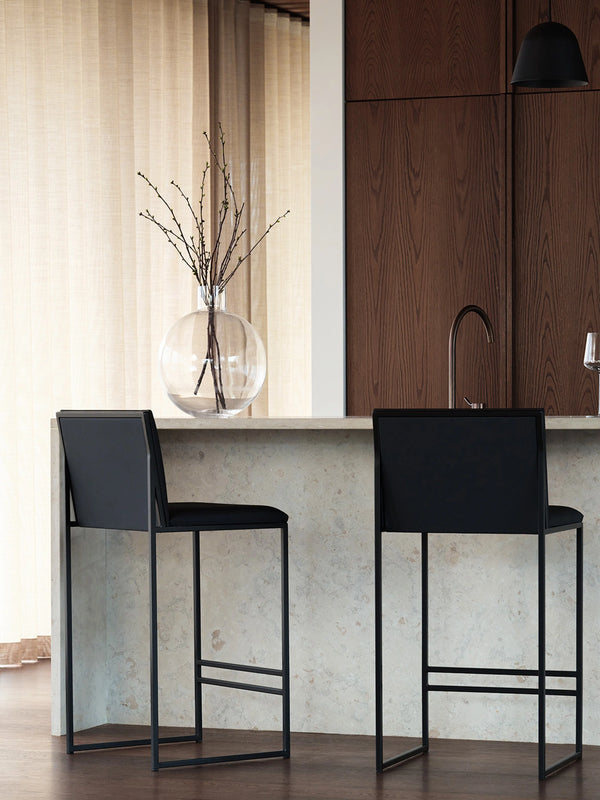
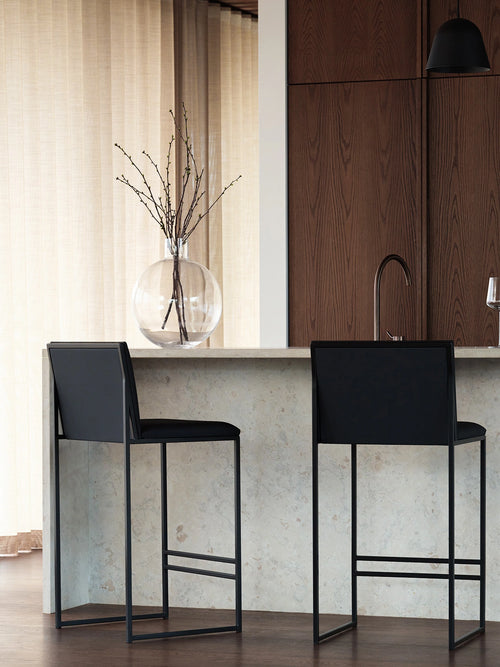
Ebba oak bar stools and Svea steel stool at a compact pale kitchen island showing how correctly proportioned stools fit a small island without crowding.
Small kitchen islands reward precise buying decisions more than large ones. A stool that is 3 cm too wide, 2 cm too tall, or 5 cm too deep to tuck under the counter creates a daily inconvenience that does not improve over time.
The right combination for a small island is a seat width of 38-40 cm, a backless or low-back profile, a slim frame, and a seat height matched exactly to the counter. Within those parameters, material and finish are a style choice. Outside them, the stool works against the kitchen rather than with it.
At by Crea, the Svea and Ebba stools are the most compact in the range. Both are available at 66 cm (26") as standard. Custom heights are available for non-standard counter heights.
Related guides
Kitchen island seating guide: spacing, overhang, and stool count
How many bar stools do I need?: calculation method for any island length
How much legroom do bar stools need?: seat height measurement guide
Browse compact bar stools
All bar stools: filter by height and backrest type
Wooden bar stools: Ebba and Eva for minimal footprint
Small kitchen islands reward precise buying decisions more than large ones. A stool that is 3 cm too wide, 2 cm too tall, or 5 cm too deep to tuck under the counter creates a daily inconvenience that does not improve over time.
The right combination for a small island is a seat width of 38-40 cm, a backless or low-back profile, a slim frame, and a seat height matched exactly to the counter. Within those parameters, material and finish are a style choice. Outside them, the stool works against the kitchen rather than with it.
At by Crea, the Svea and Ebba stools are the most compact in the range. Both are available at 66 cm (26") as standard. Custom heights are available for non-standard counter heights.
Related guides
Kitchen island seating guide: spacing, overhang, and stool count
How many bar stools do I need?: calculation method for any island length
How much legroom do bar stools need?: seat height measurement guide
Browse compact bar stools
All bar stools: filter by height and backrest type
Wooden bar stools: Ebba and Eva for minimal footprint
The minimum comfortable island length for two bar stools is 100-110 cm (39-43"). This allows 50-55 cm per stool. Below 100 cm, two adult-sized stools feel crowded and elbow room is reduced. For islands under 90 cm along the seated edge, a single centrally placed stool is often the more practical choice.
Yes. Backless stools are the best choice for small kitchens because they tuck completely under the counter when not in use, freeing the walkway. They also have a smaller visual mass than backrest stools, which makes the kitchen feel less cluttered. The trade-off is comfort duration: backless stools work best for sittings under 25 minutes.
A seat width of 38-40 cm is the practical range for small kitchen islands. This provides adequate seating comfort for adult use while keeping the stool footprint compact. Seats wider than 42 cm require more island edge per stool, reducing the total number of seats on a short island.
Yes, comfortably. Three stools at 50 cm each occupy 150 cm of island edge exactly. For genuine comfort at 55 cm per stool, you would need 165 cm. If your island is exactly 150 cm, three stools will work but will feel tighter than the ideal. Leave at least 10 cm of clear edge at each end.
Slim steel stools with thin tubular legs allow sightlines through the frame, making a small kitchen feel more open. Wooden stools with turned or tapered legs create a slightly heavier visual presence. Both work well in small kitchens, but thin steel profiles minimise visual weight more effectively in very compact spaces.
Measure the depth of your island overhang from the edge of the counter to the base cabinet or support below. Compare this to the stool's seat depth. For a backless stool, the seat depth needs to be less than the overhang depth for the stool to sit flush under the counter. Most kitchen islands have an overhang of 30-40 cm, which accommodates most backless stools with a 38-42 cm seat depth.