Seat height gets all the attention, but seat width and depth decide how a bar stool feels once you are sitting on it. A seat that is too narrow gives you nowhere to shift; one that is too deep presses into the backs of your knees; one that is too wide takes counter space from the person next to you. The right size depends on how long you sit, how many stools need to fit, and who sits on them. This guide explains the comfortable ranges for width and depth, how seat size changes the spacing along an island, and gives the overall width and depth of every by Crea model in centimetres, measured from our own production drawings, across the armrests on Bruno and Carl.
What seat size should a bar stool have?
For everyday meals and longer sits, we recommend a seat about 41 to 47 cm wide and 37 to 43 cm deep for most adults.
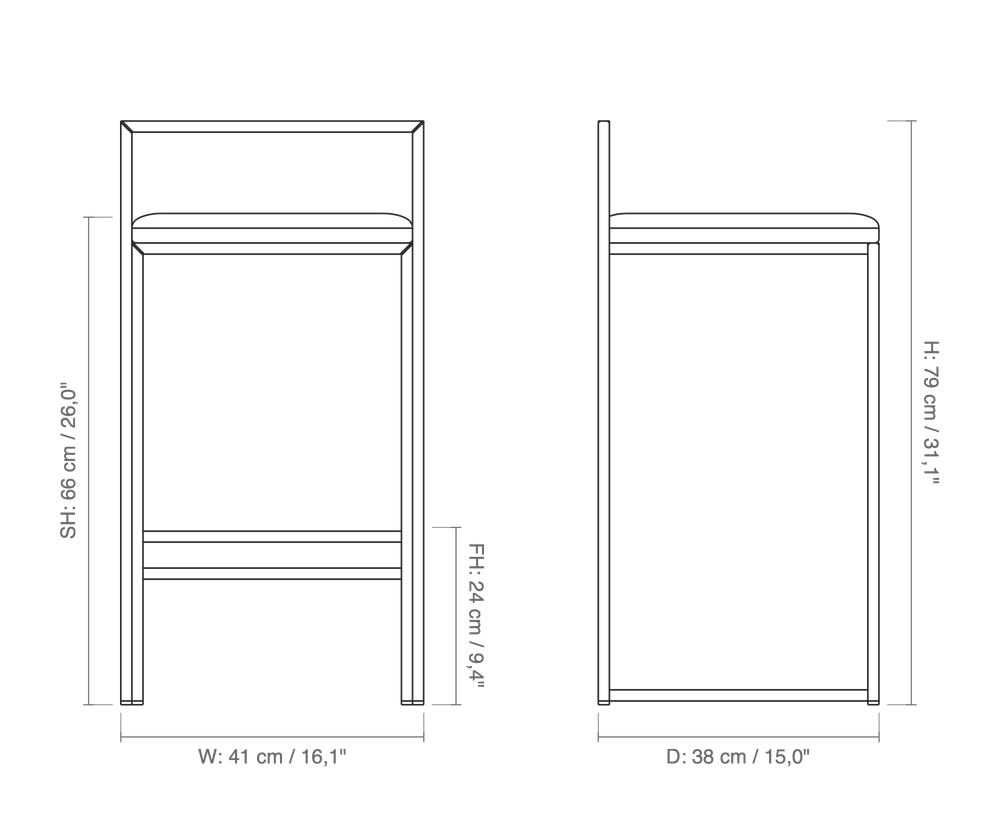
Freja's production drawing: 41 x 38 cm overall on a 66 cm frame.
Narrower seats of around 38 cm work well for shorter sits and small islands. Seats over 50 cm wide feel like a chair and need more counter space.
The table gives the overall width and depth of every by Crea model from our production drawings, measured at the widest point, which on Bruno and Carl is across the armrests. Width is the figure that decides spacing; depth decides how well your thighs are supported.
Overall width and depth of every by Crea bar stool; Bruno and Carl measured across the armrests
Yes, over longer sits. A wider seat lets you shift your weight and change position, which most people find keeps them comfortable through a long dinner; a narrow seat holds you in one position.
For a quick coffee the difference is small, for an hour it is large.
Width is not the only factor: a narrow padded seat with a backrest is usually more comfortable than a wide hard seat without one. But if you plan to eat most meals at the island, a seat of 41 cm or more is usually worth the extra counter space. Our guide to comfortable bar stools weighs all five comfort factors.
What seat depth is comfortable?
Our recommended range is about 37 to 43 cm for most adults.
A seat in that range supports most of the thigh without the front edge pressing into the backs of the knees. Too shallow and you perch on the front; too deep and you either sit forward, away from the backrest, or the seat edge presses behind your knees.
Depth matters more on stools with a backrest, because it sets how far you sit from it. Philip's and Bruno's 37 cm depth keeps the backrest within reach for most people; Carl's 43 cm depth gives a more lounge-like seat that tends to suit taller adults.
How does seat width affect how many stools fit?
As a starting point, allow about 55 cm of counter per stool for seats of 44 to 47 cm, 50 cm for slim seats up to about 41 cm, and 60 cm for seats over 50 cm wide.
That leaves about 10 cm between neighbouring seats, the gap most people need to get on and off without bumping each other.
On a short island, narrow seats can win a stool: at 50 cm per seat, three 38 cm stools fit along 150 cm, where two wider stools would. On a long island, the extra comfort of a wider seat usually matters more. See how many bar stools fit your island for the calculator.
Do armrests change the seat size I need?
Armrests add width and set the limits of the seat.
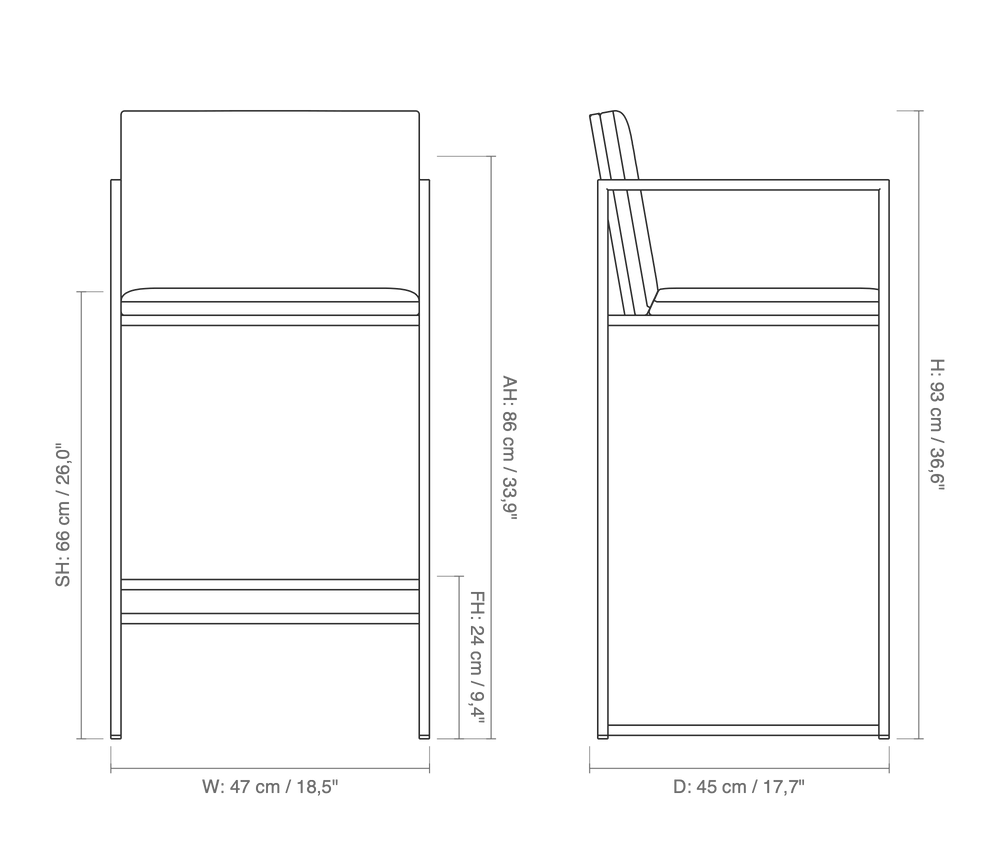
Bruno: 47 cm wide across armrests that sit at 86 cm.
On a stool with armrests, the space between them is where you sit, so a stool with armrests needs a generous seat to feel comfortable. The counter space we recommend follows the width across the armrests: 55 cm for Bruno at 47 cm, and 60 to 65 cm for Carl at 54 cm.
Armrests also need to pass under the counter edge; on Bruno they sit at 86 cm with a 66 cm seat. For people who find it hard to get up from a high seat, armrests are worth having. Compare backrests and armrests in backrest vs backless stools.
Which seat size suits taller or larger people?
Usually a wider and deeper seat, with a backrest: Ted at 45 x 40 cm overall, Bruno at 47 x 37 cm or Carl at 54 x 43 cm, both measured across the armrests.
They give room to shift and support the whole thigh. All our stools carry the same 200 kg load rating.
Children and shorter adults are usually comfortable on narrower seats with a backrest and a footrest, such as Freja or Ebba. If a household includes both, mixing models of the same seat height and frame colour along one island usually works well. See bar stool weight capacity for more on strength.
Seat size in brief
41 to 47 cm
Width for long sitting.
38 cm
For short sits and small islands.
55 cm
Counter per stool; 50 cm for slim seats.
As a rule of thumb, choose 41 to 47 cm of seat width and 37 to 43 cm of depth for long sitting, 38 cm for short sits and small islands, and allow 55 cm of counter per stool, 50 cm for slim seats and 60 cm for seats over 50 cm. Every by Crea model is listed above with its exact dimensions, comes in 66 and 76 cm seat heights and is made in our own factory in Malmö, Sweden, with a 10-year warranty.
Frequently asked questions
How wide should a bar stool seat be?
We recommend about 41 to 47 cm for long sitting, and around 38 cm for short sits and small islands.
What is a comfortable bar stool seat depth?
We recommend about 37 to 43 cm, which supports the thighs without the seat edge pressing behind the knees.
Which by Crea stool is the widest?
Carl, at 54 cm across the armrests and 43 cm deep.
Which by Crea stool has the narrowest seat?
Eva, Svea and Ebba, at 38 cm wide, which suit short sits and fit more stools along an island.
Does a wider seat mean fewer stools?
Sometimes. As a starting point, allow 55 cm of counter per stool for most seats, 50 cm for slim seats up to about 41 cm, and 60 cm for seats over 50 cm.
Is a bigger seat more comfortable?
For long sits, yes, up to about 47 cm wide. A backrest and footrest matter as much as seat size.